
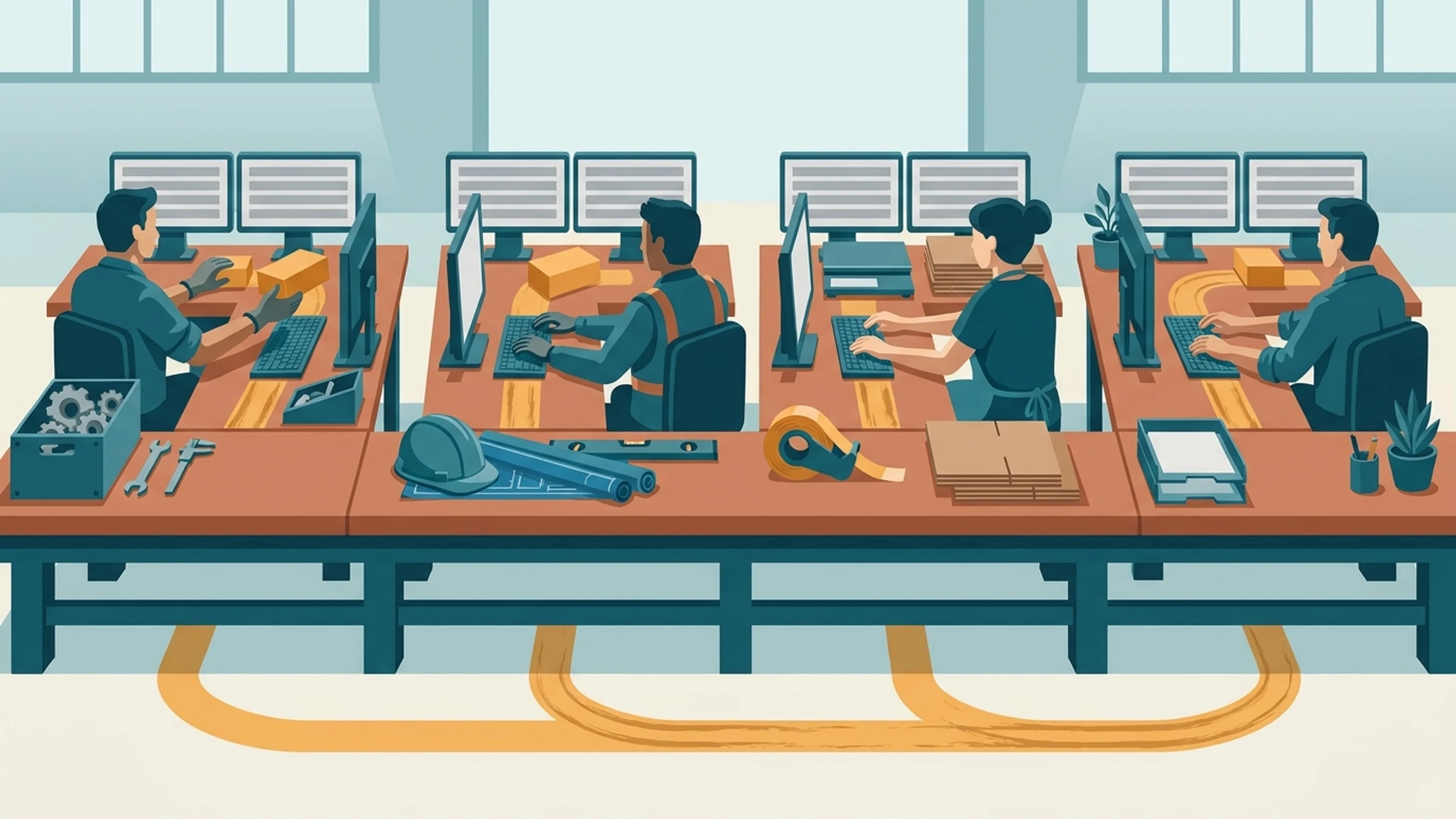
Most automation advice starts with a tool and works backwards to a problem. That is why so much of it ends in a half-built flow nobody trusts. The automation worth doing starts somewhere much less exciting: a person on your payroll, reading a number off one screen and typing it into another, every single week. Find those handoffs and you have found your automation list. There are usually only two or three of them, and one is worth more than the rest combined.
What business process automation actually means
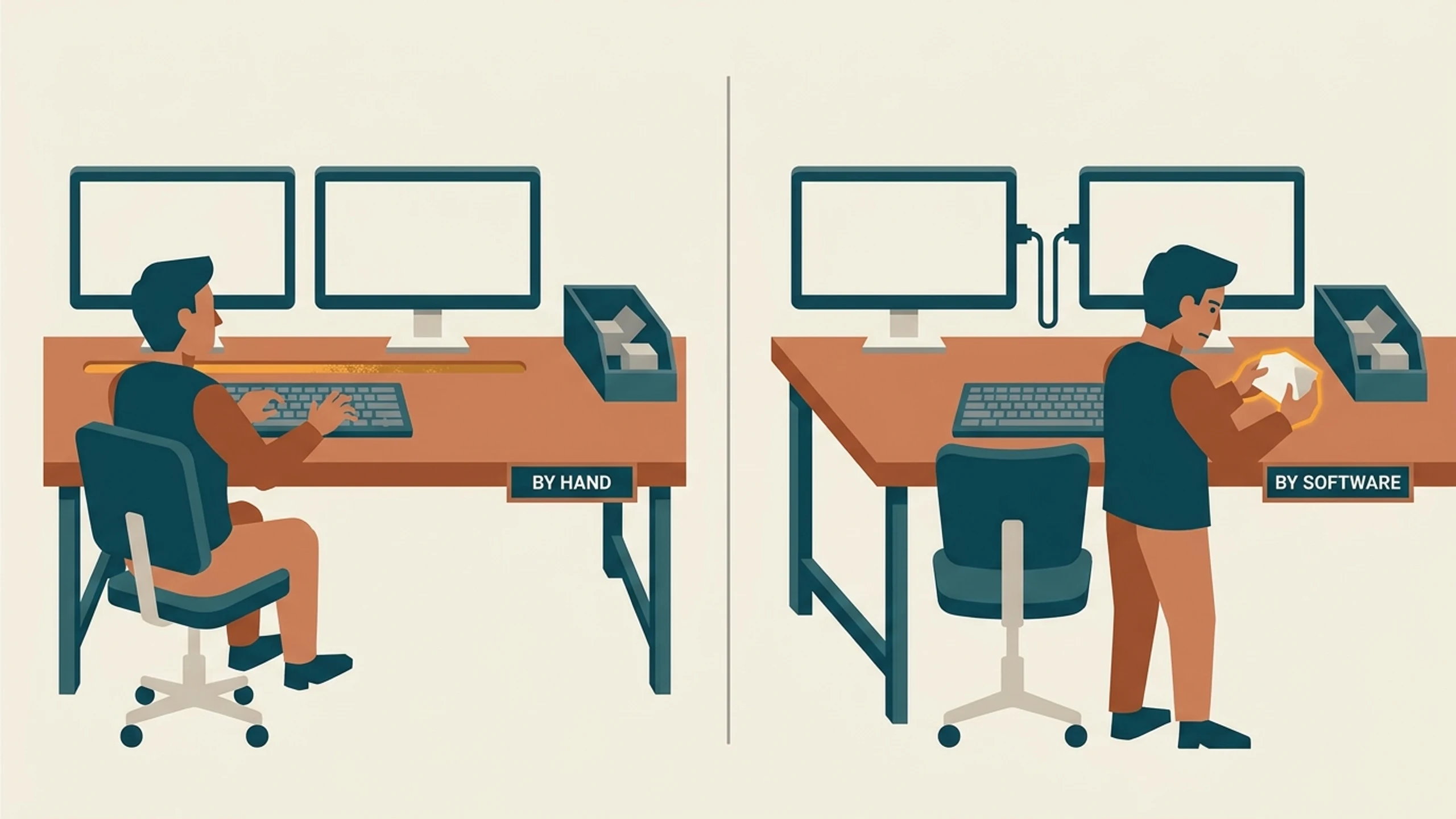
Business process automation is letting software carry a handoff that a person carries by hand today. That is the whole definition. It is not artificial intelligence, it is not a platform, and it does not require anyone to work differently. The work still happens in the same order, with the same steps and the same people. The retyping in the middle stops.
The distinction that matters is between a task and a handoff. Automating a task means doing something faster. Automating a handoff means the work no longer stops and wait for a person to move it. The second is where the money is, because the cost of a handoff is not the ten minutes of typing. It is the two days the work sat still before someone got to it.
Nine examples from real builds
If the word itself is doing you no favours, we wrote a plain-English definition of automation in business first. These are handoffs we have replaced for small and mid-sized companies. Each one existed as a person and a keyboard before it existed as software.
- Quote to shop floor. An estimator prices a job in a workbook, then retypes it into the job system. A mold shop quoting tool takes same-day quotes off the same numbers the floor already uses.
- Scope library to owner-ready PDF. A general contractor assembles bids by copying language out of past proposals. A bid builder holds the scope library and renders the document.
- Order intake across channels. Orders arrive by email, phone, and portal, and someone keys all three into one system. Multi-channel order intake unifies them before anyone touches a keyboard.
- Rebate accrual. A distributor tracks vendor rebate tiers in a spreadsheet and reconciles at quarter end. A rebate tracker accrues as orders land.
- Change order to billing. A change order gets signed in the field and reaches billing days later. A mobile change-order tool closes that gap the week it is signed.
- Completed job to invoice. Work finishes, and someone builds the invoice and the technician commission by hand. Auto-invoicing with commissions does both from the job record.
- Inbound call to CRM. A call comes in and the details are written on paper first. Call-to-CRM routing puts the record where the follow-up will happen.
- Client onboarding. A new client triggers a checklist that lives in one person's head. Onboarding software runs the sequence and shows where each client is.
- Status questions. Customers call to ask where their order is, and someone stops work to look it up. A customer portal answers it without the call.
Nothing in that list is exotic. Every one is a place where information already existed and a person was moving it.
The test for which one to automate first
Three questions, in this order. They take about an hour with a notebook.
1. Who is the person in the middle?
Name them. If you cannot name a specific person who performs the handoff, it is not a handoff, and automating it will save nothing. The office manager, the estimator, the dispatcher, the bookkeeper. Real people doing real steps.
2. How many hours a week, and at what fully loaded cost?
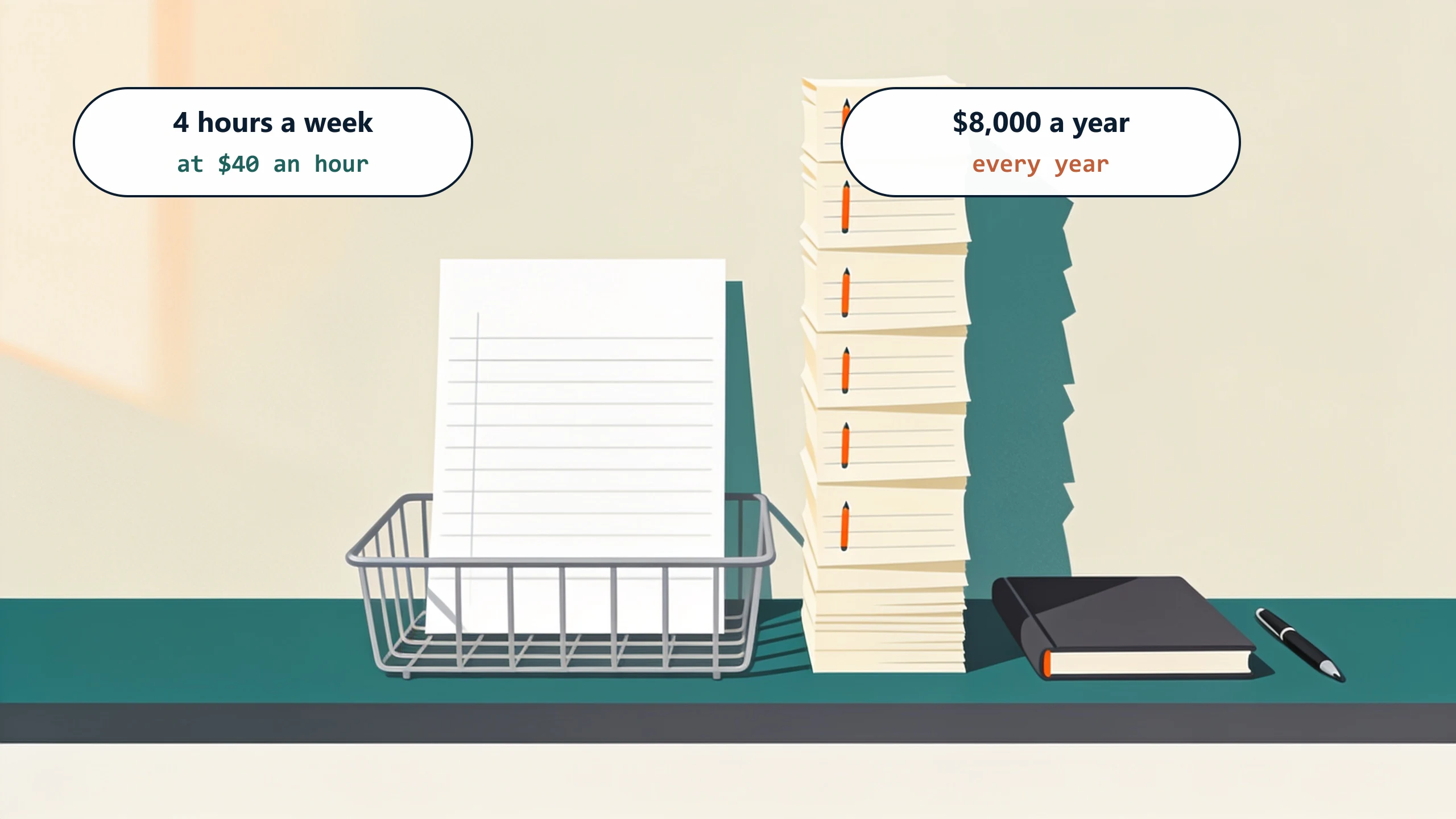
Ask the person, not the org chart. Multiply the weekly hours by fifty weeks and by their fully loaded hourly cost. A handoff that takes four hours a week from someone costing $40 an hour fully loaded is $8,000 a year, every year, and it does not appear on any software invoice.
3. What does the delay cost on top of the labor?
This one is often larger than the salary. Work sitting still has a price: a change order billed two weeks late is two weeks of cash flow, an order that waits for manual entry is a delivery date you cannot promise, and a quote that takes three days is bids you lose to whoever answered first.
Rank the handoffs by the sum of the second and third numbers. The top one is where to start, and it is usually not the one that annoys people most.
Where automation stops paying
Two cases, and both are common enough to name.
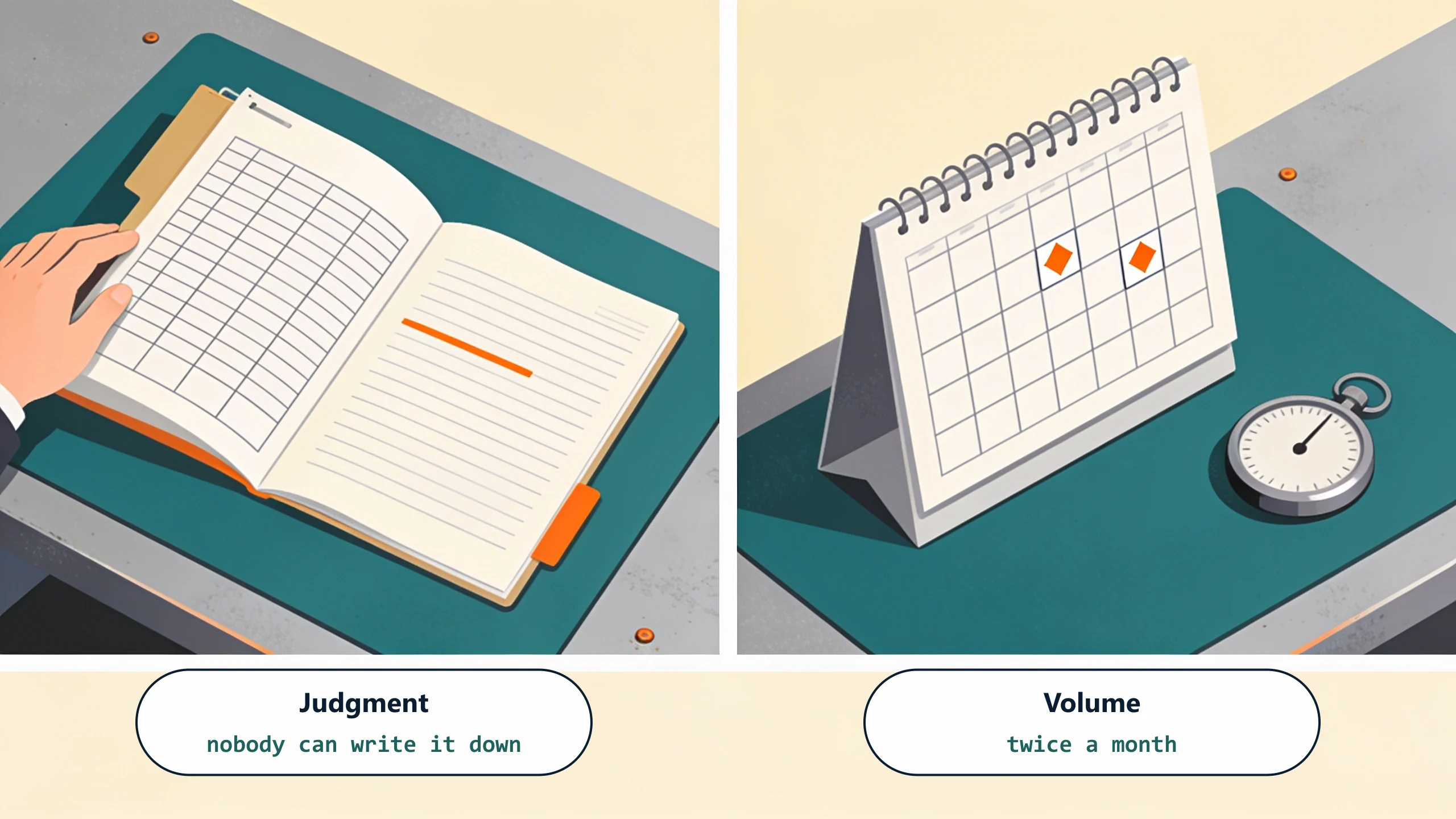
The first is judgment. If the step requires someone to weigh something that is not written down anywhere, the answer is that the software should hand it to a person with everything gathered, and stop there. Attempting to encode a judgment nobody can articulate produces a flow the team routes around within a month.
The second is volume. A handoff that happens twice a month is rarely worth building around, even when it is irritating. Frequency is what turns a small friction into a real number, which is why the hours-per-week question comes before anything else.
There is also a middle path worth naming. Some handoffs are standard enough that a connector tool handles them, and you should use one when it fits. The threshold where connector tools stop working is specific and recognizable: conditional logic that branches more than a few ways, or a flow that needs to remember something between runs.
What to do this week
Spend an hour with whoever moves information between systems. Write down every step where they read from one place and type into another. Put hours per week next to each, and add a note about what waits while it happens. That single page is worth more than any tool comparison, because it tells you which handoff is expensive and which is merely annoying.
If you want a second opinion on that page, book a free 30-minute discovery call. We will tell you which handoff we would build first, and which ones a connector tool handles for a fraction of the cost.
No pitch, no pressure. We diagnose, you decide.
Have a question? We reply by email, no call needed.