
Custom software is the right answer for some SMEs and the wrong answer for most. The line between the two is not a feeling. It is seven specific signs. If three or more apply to your business, custom is worth scoping. If fewer than three apply, stay on SaaS.
The seven signs
Any one of these is survivable on its own. How many apply at once is what tells you whether the software is still fitting the business.
1. You have a "workaround document"
Your team maintains a document, usually a Google Doc or a OneNote page, that explains how to use your software the way your business actually works. Step 1 says "ignore the field that says X, we use it for Y instead." Step 2 explains the workaround for the case the SaaS does not handle. If this document exists, you have already paid for software that does not fit. The workaround document is software that has not been written yet.
2. You renew SaaS subscriptions you cannot remember the purpose of
Quarterly review. Your bookkeeper highlights three recurring charges and asks "what are these for." You shrug. They came in when you needed to fix something specific, you fixed it, the subscription stayed. Your stack is a graveyard of solved problems with monthly bills.
3. The same data lives in three or more places, manually kept in sync
Customer master data in the CRM, the billing system, and the support system. Inventory levels in the ERP, a spreadsheet, and a portal. Someone on your team is responsible for keeping all three in sync. Software with a single source of truth eliminates this role entirely.
4. Customer-facing experience is materially worse than your competitors
Your prospects can see what your competitors offer. If your top competitor has a customer portal, a self-service ordering tool, or real-time status visibility, and you do not, you are losing accounts you do not even know you are losing. The lost-account cost is rarely tracked but it is real.
5. Hiring more office staff has stopped scaling
You added a person to the office two years ago to handle the increasing reconciliation work. The work has grown faster than the new hire absorbed. You are now considering adding another person. The cycle: each new hire absorbs a year of growth before you need the next one. Software absorbs growth without the marginal cost of hiring.
6. You have lost an employee who was the only person who understood "how it all works"
Your operations manager left. Their knowledge of how to run the spreadsheet stack went with them. Three months later, you are still finding things they did that nobody else knew about. Institutional-knowledge concentration in a single person is a financial risk. Custom software encodes the knowledge so it does not walk out the door.
7. The DIY automation platform has become its own bottleneck
You built complex Zaps to bridge SaaS gaps. They work, mostly. They break unpredictably. Maintaining them is now a part-time job for someone on your team. The Zaps were supposed to be the solution, and they have become a new layer of the problem. Read our decision framework on this exact transition.
What each sign actually means
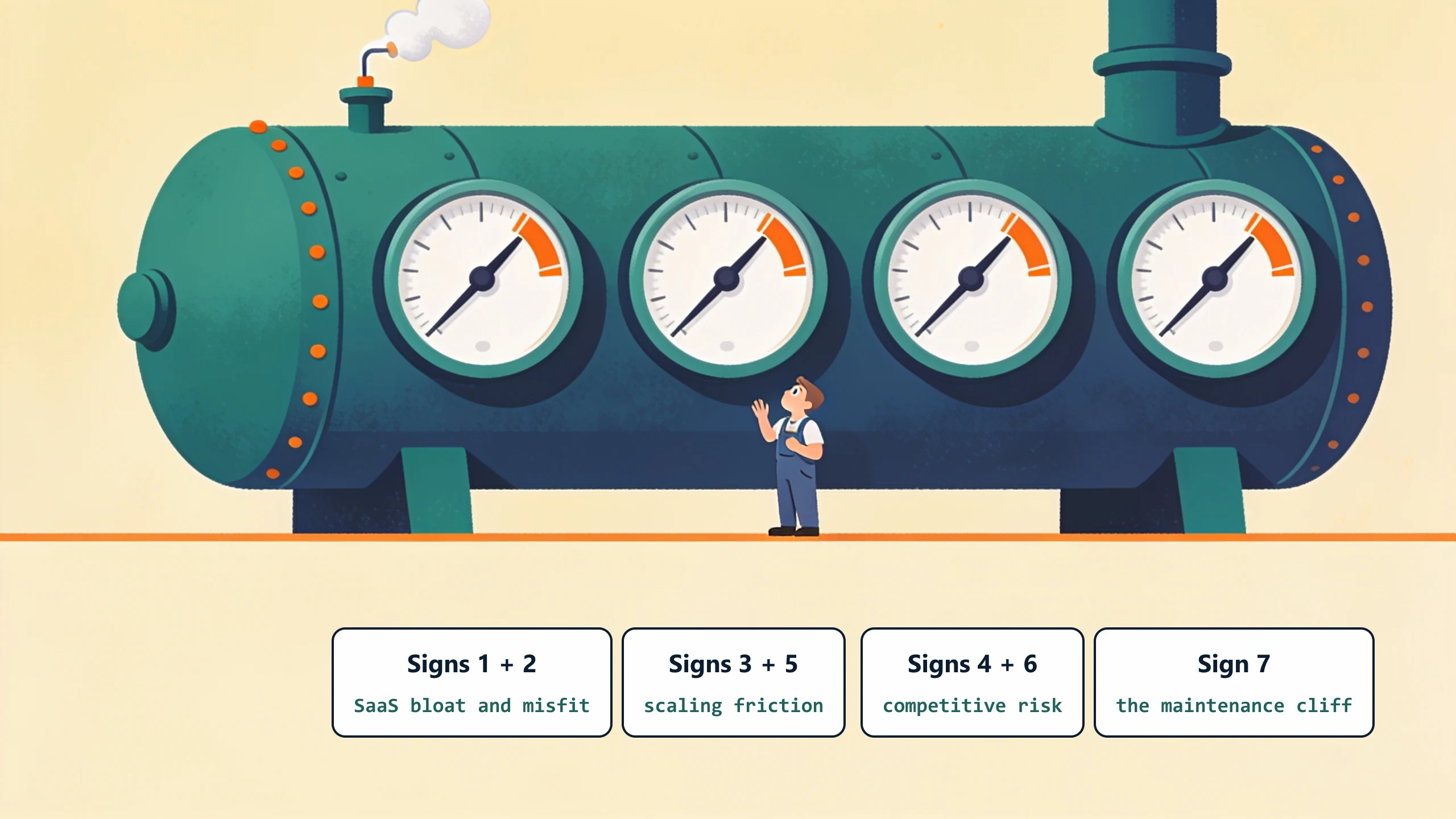
Signs 1 and 2 are about SaaS bloat and misfit: you are paying for tools that do not match your business. Custom software fits because it is built around your business, not around a generic template.
Signs 3 and 5 are about scaling friction: your current stack does not absorb growth. Custom software (with proper integration) does, because the marginal cost per transaction approaches zero.
Signs 4 and 6 are about competitive risk: your competitors are pulling ahead in customer experience and operational resilience. Custom software addresses both.
Sign 7 is about maintenance cliff: DIY automation has its own ceiling, and you have hit it. Custom-plus-managed software eliminates the maintenance question by contract.
Three signs is the threshold
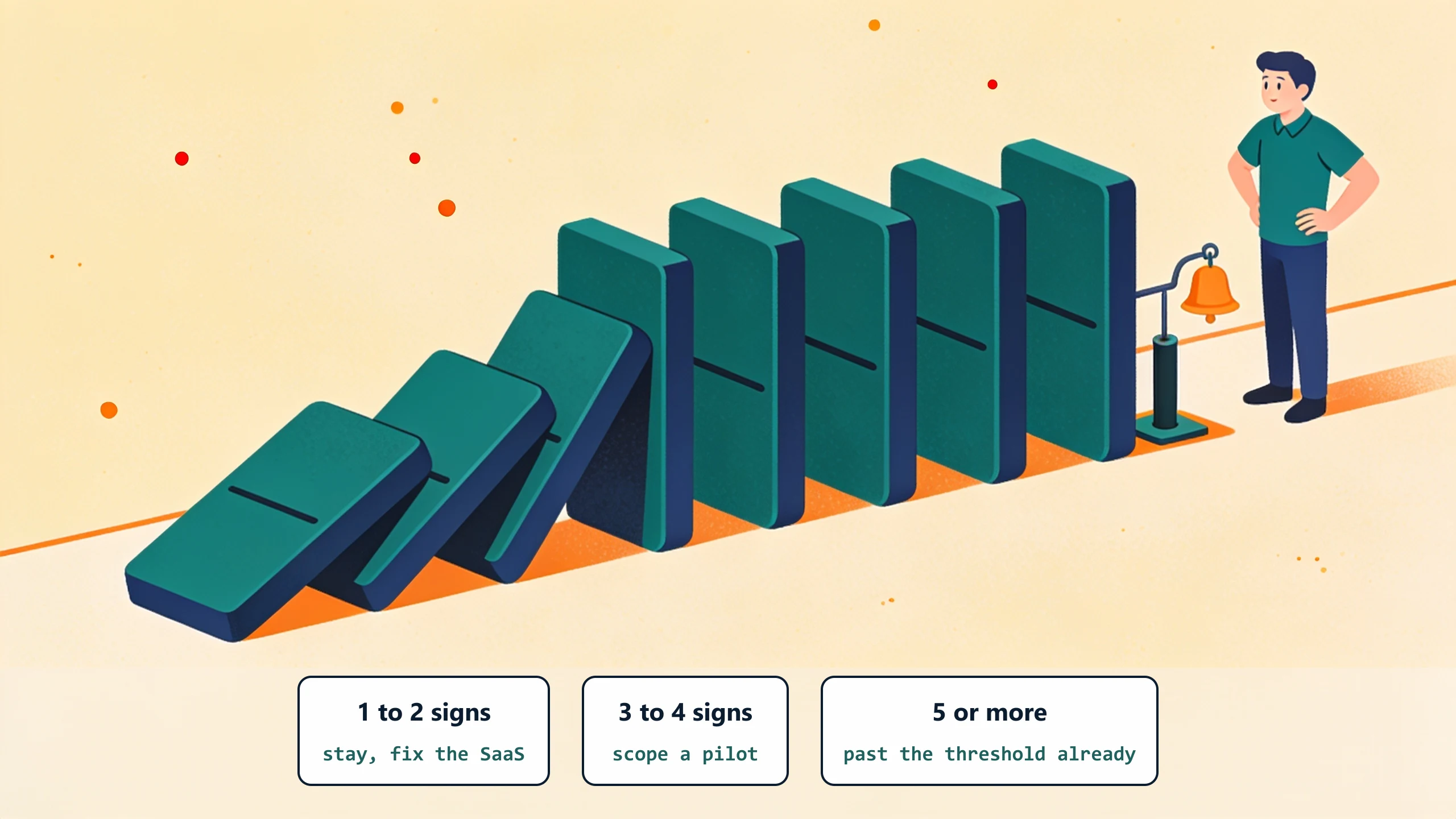
One or two signs: stay on SaaS, fix the specific issue.
Three to four signs: scope a custom-software pilot for the most painful issue. Read our cost framework to determine which delivery model fits.
Five or more signs: you have been past the threshold for a while. The longer you wait, the more compound cost you absorb. Start with the workflow that costs you the most and pilot it.
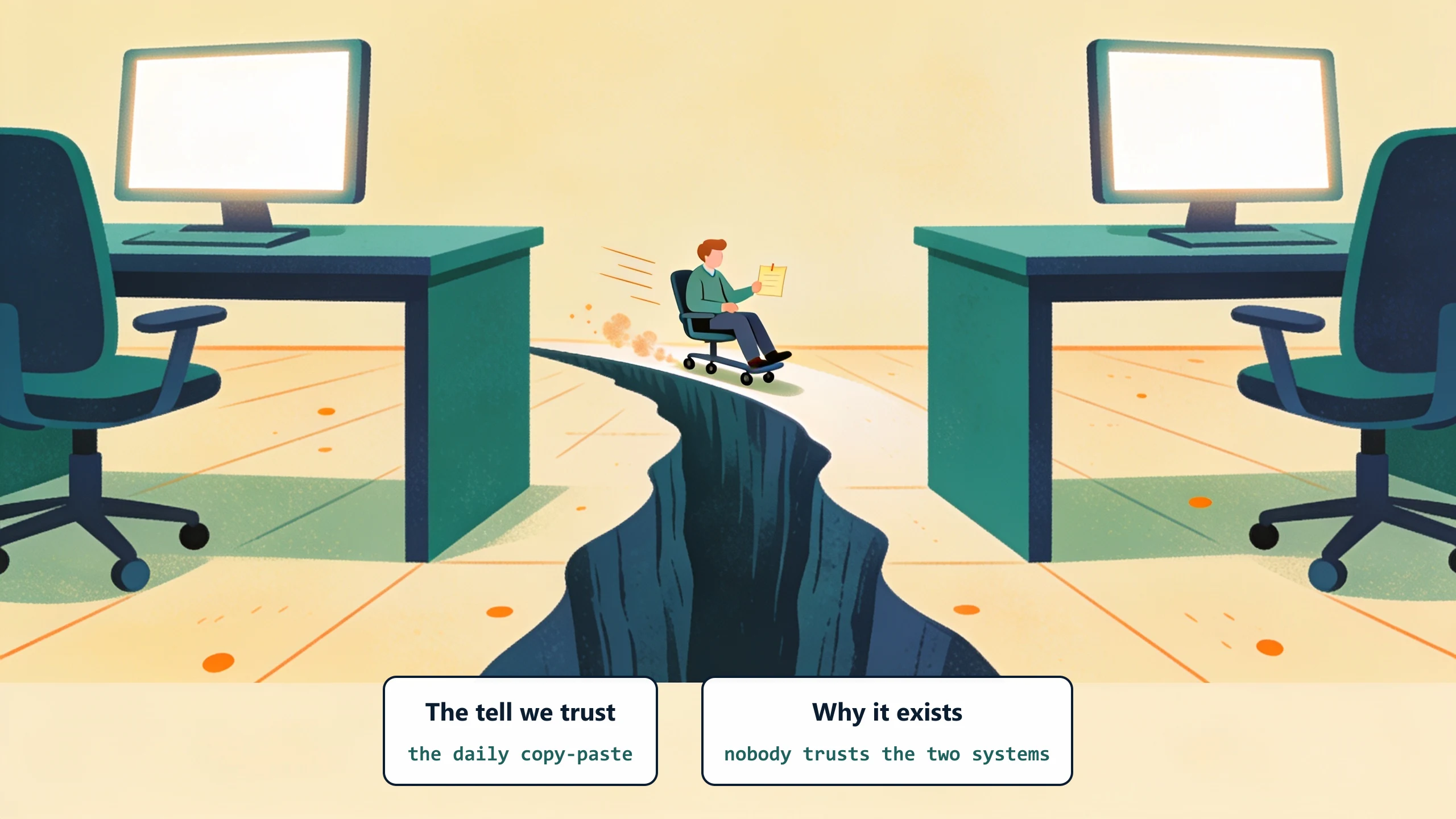
The signal we trust most is not on this list, because it only shows up once you watch a team work: a daily copy-paste of the same numbers from one system into another, done by hand because nobody trusts the two to agree on their own. In the pilots we run, that one keystroke predicts a build worth doing more reliably than anything an owner self-reports.
What to do this week
Print this post. Mark each sign as "applies to us" or "does not apply." Walk us through the marked ones on a free 30-minute discovery call and we will tell you whether the count justifies a pilot or whether you should fix the SaaS first.
No pitch, no pressure. We diagnose, you decide.
Have a question? We reply by email, no call needed.