

For an SME owner trying to decide between yet another SaaS subscription and a custom-software build, the decision is usually framed in vibes ("we just need something that fits"). It should be framed in three numbers. Those numbers are the framework.
The three numbers that determine the answer
Number 1: Annual SaaS cost for the workflow
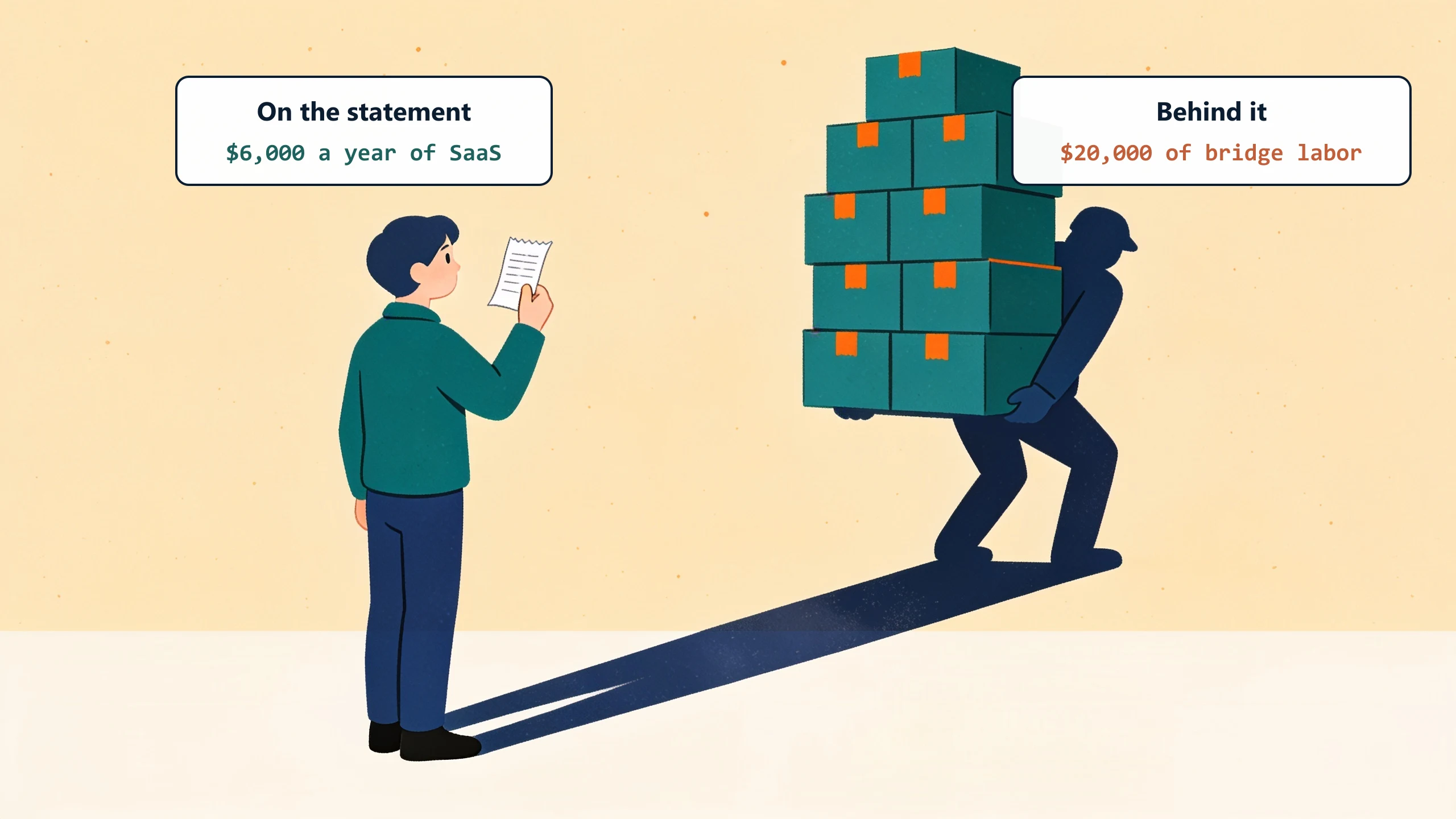
Add up every recurring subscription that touches the workflow. The CRM ($200/mo), the CRM-to-QuickBooks connector ($50/mo), the workflow tool ($100/mo), the reporting tool ($150/mo). Annualize the total: $6,000 in this example. This is the running cost you would eliminate or partially eliminate by building custom.
Most owners underestimate this number because they only look at the line items they associate with the workflow. Look at the bank statement. Add everything up.
Number 2: Annual hidden labor cost (the "person in the bridge")
Identify who on your team manually bridges the SaaS gaps. The office manager who copies data between systems. The bookkeeper who reconciles. The salesperson who updates the CRM by hand. Estimate hours per week. Multiply by 50 and by their fully-loaded hourly cost.
Common case: 10 hours per week at fully-loaded $40 per hour = $20,000 per year. This is the hidden tax of the SaaS-with-gaps approach. It does not show up on the credit card statement. By the time the SaaS bill lands each month it looks small, but the bridge labor behind it is usually the bigger number, and an owner rarely has it on paper until we count the hours the manual copying really takes. That is what the pilot is built to surface: the recovered hours show up inside 30 days, before anything graduates to a monthly tier.
Number 3: Annual cost of the custom alternative
Three paths and their annual costs:
- Custom-plus-managed (the model ByteQuix uses): a one-time pilot fee in year one, then a flat monthly fee at the relevant tier, lower again from year two onward with no additional maintenance bills.
- Project-based dev shop: $25,000 to $75,000 build in year one. Then $500 to $2,000 per month for ongoing support. Year-one annual: $31,000 to $99,000. Year-two onwards: $6,000 to $24,000. High variance. Maintenance cliff risk.
- Internal hire: $90,000 to $150,000 fully loaded for a US-based developer. Plus tooling, plus management overhead. Year-one annual: $90,000 to $150,000. Same year-two onwards.
The decision math
SaaS-with-gaps cost = Number 1 + Number 2.
Custom alternative cost = Number 3 (pick the relevant path).
Custom is the better financial choice when (Number 1 + Number 2) is greater than Number 3, after accounting for the implementation timeline.
Worked example
A 25-person commercial cleaning company. Workflow: scheduling, invoicing, and customer communication for recurring contracts.
- Number 1 (annual SaaS cost): $9,800. Field service software ($350/mo), QuickBooks Online ($90/mo), customer-portal add-on ($250/mo), Zapier ($50/mo). Annualized: $9,800.
- Number 2 (annual hidden labor): $30,000. Office manager spends 15 hours per week reconciling and answering "did you come last Thursday" calls. At $40/hour, that is $30,000.
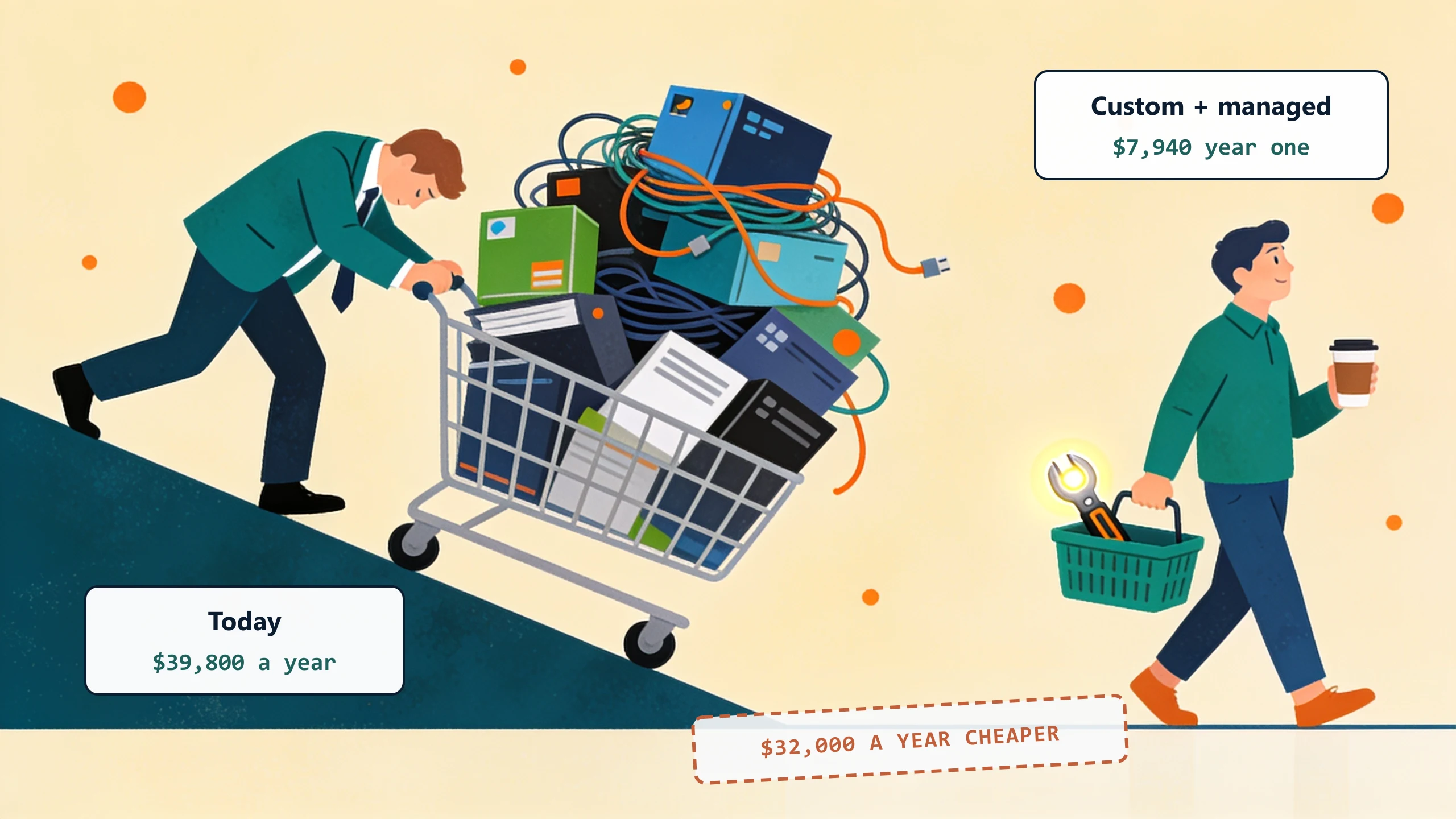
- Total current cost: $39,800/year.
- Number 3 (custom-plus-managed Growth tier): a one-time pilot fee in year one, then a flat monthly fee, lower again from year two onward.
The custom alternative comes in well under the $39,800 current cost, recovers half the office manager's time, and addresses the customer-experience gap that has been costing them accounts. The math is not even close.
Counter-example
A 12-person accounting firm. Workflow: client document collection during tax season.
- Number 1: $1,200/year. They use SmartVault ($100/mo) for the document portal.
- Number 2: $2,500/year. Two interns spend a few hours a week chasing documents during tax season.
- Total current cost: $3,700/year.
- Number 3 (custom-plus-managed Starter): a one-time pilot fee in year one, then a flat monthly fee, roughly on par with the $3,700/year current cost.
The custom alternative roughly breaks even financially. Without a strong qualitative reason (e.g., the existing portal is causing client churn), stay on SmartVault.
Where SaaS wins
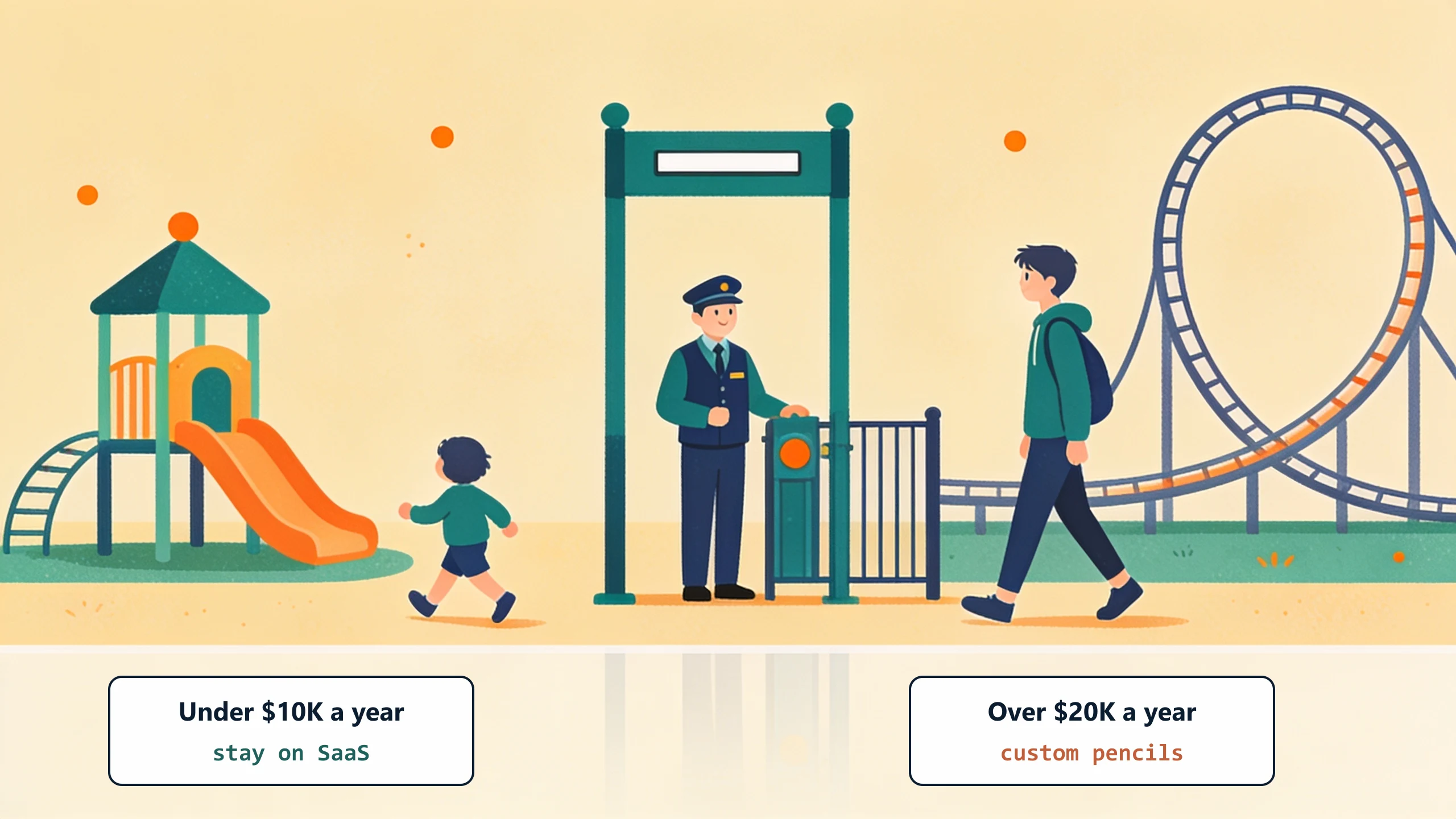
SaaS wins when Number 1 + Number 2 is small (under $10,000 per year combined). At that level, custom software does not pencil even if it would technically be a better fit. Stay on SaaS. Live with the gap.
SaaS also wins when the workflow is genuinely standard and your business is not bending around the SaaS limitations (you found a SaaS that fits). Do not build custom for the sake of building custom.
Where custom wins
Custom wins when Number 1 + Number 2 is large (over $20,000 per year combined) AND the workflow is bespoke enough that no SaaS will close the gap. This is the typical SME with one specific workflow that has been bleeding hours for years.
What to do this week
Run the math. Pull up your last credit-card statement and your last bank statement. Get Numbers 1 and 2 down on paper. Walk us through the result on a free 30-minute discovery call. We will tell you whether the math says custom or whether it says stay on SaaS.
No pitch, no pressure. We diagnose, you decide.
Have a question? We reply by email, no call needed.