

Every SME runs on spreadsheets at some point. Most should. The question is when to stop. If three or more of these seven signs apply to your business, you are past the threshold. Your spreadsheets are now costing you more than they save.
The seven signs
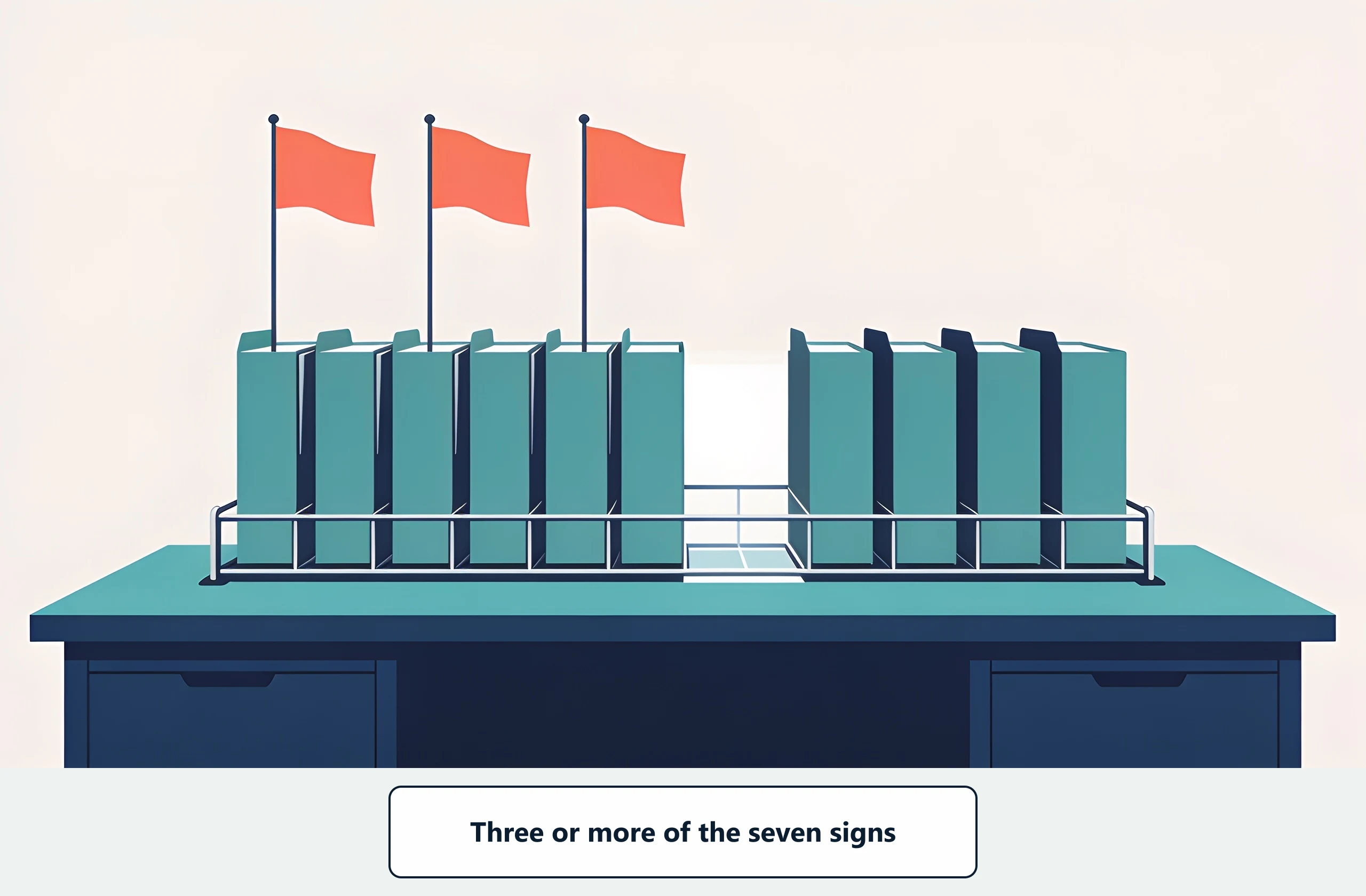
Owners rarely have just one of these. Three is the line where the spreadsheet stops being the cheap option and starts being the expensive one.
1. The spreadsheet has a single owner who cannot take vacation
You have a key spreadsheet (quoting calculator, scheduling sheet, AR aging file, commission tracker) that one person on your team maintains. When they are out for a week, the workflow stops. Their backup looks at the spreadsheet and does not understand the formulas. This is the single clearest sign of spreadsheet-as-bottleneck. Software does not get tired, take vacations, or quit.

2. The same number is computed in three different files
Your monthly revenue. Your project margin. Your tech utilization. Your AR aging. Pick any KPI. If you can find that number computed differently in three different spreadsheets owned by three different people, you no longer have a number. You have a debate. Software with a single source of truth does not have this problem.
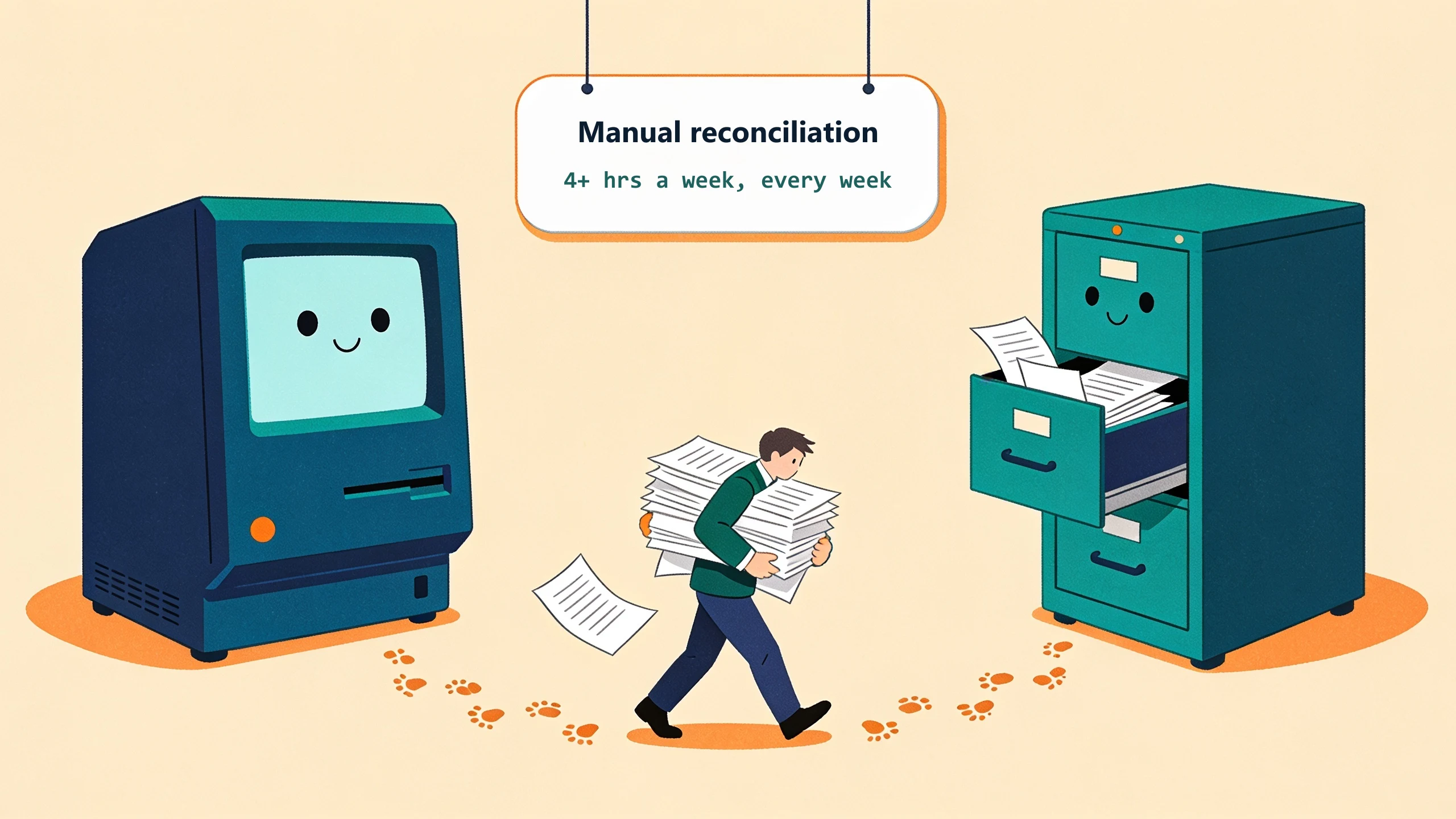
3. Manual reconciliation eats more than 4 hours a week somewhere
Someone on your team is spending the equivalent of half a day per week comparing two systems and fixing the differences by hand. Common cases: ERP versus QuickBooks invoicing, CRM versus billing, dispatch versus payroll, inventory versus purchasing. The manual reconciliation is software that has not been written yet.
4. New hires take more than three months to ramp
If a new office manager or new operations hire needs three or more months to be productive, the gap is institutional knowledge living in spreadsheets that nobody else can read. The hidden cost is real: ramp time is salary spent before productivity returns.
5. Customer-facing experience is "we will get back to you"
Customer asks "did you ship my order yet" or "what is the status of my project" or "can I get a copy of last month's invoice." Your team's answer is "let me check and get back to you." Your team is checking three spreadsheets. Larger competitors have a portal that answers the question in real time. You are losing accounts to that.
6. You have hired a controller (or a part-time CFO) primarily to wrangle spreadsheets
If your most expensive accounting hire spends most of their time consolidating spreadsheets rather than analyzing the resulting numbers, you have hired a tool, not a strategist. The strategist exists. The spreadsheets are eating their hours.
7. Errors that should not happen, keep happening
Wrong invoice sent to the wrong customer. Two techs scheduled for the same job. PO placed on the wrong vendor. Each one is a one-off mistake. Together, they are the same failure repeating. Spreadsheets do not enforce constraints. Software does.
The thing we flag first in a sprawl audit is the file no one can fully explain, including the person who built it. When the tabs and formulas a business runs on every day live in exactly one head, that is the single point of failure we point to when we pick which spreadsheet to replace first.
What each sign actually tells you
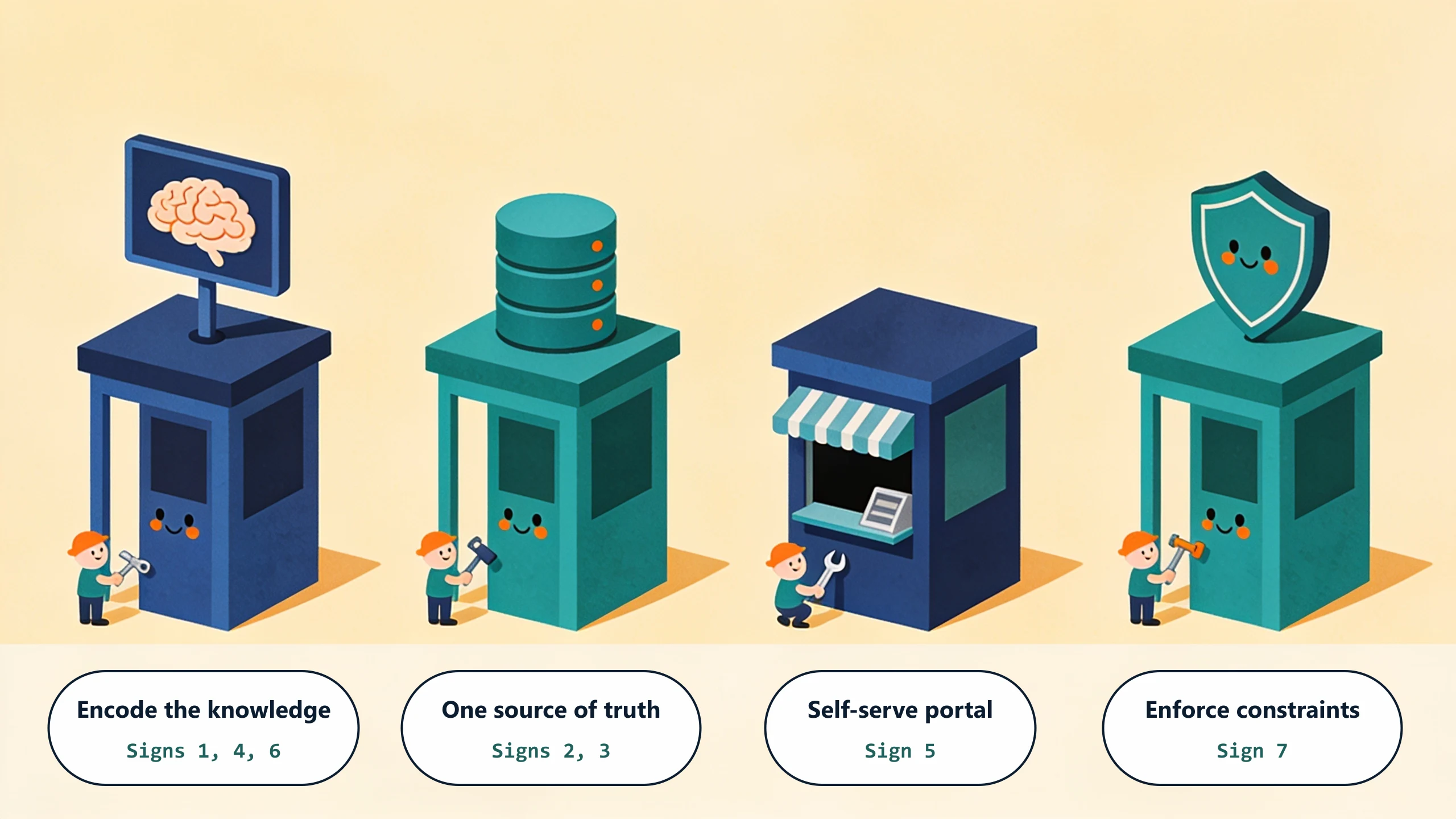
The seven signs map to four classes of fix:
- Signs 1, 4, 6: Institutional-knowledge concentration. Fix: software that encodes the knowledge so it does not live in one person's head.
- Signs 2, 3: System-of-truth fragmentation. Fix: software that pulls from authoritative sources and computes derived numbers automatically.
- Sign 5: Customer-experience gap. Fix: a self-service portal layer on top of your existing systems.
- Sign 7: Constraint enforcement. Fix: software that prevents impossible states (two techs at the same job) before they are entered.
What comes after the spreadsheet
The decision is not "replace all spreadsheets with software." Spreadsheets remain great for ad-hoc analysis, modeling, and scratch work. The decision is which specific spreadsheet (the one that triggered the most signs) gets replaced with a tool that does the same job without the hidden costs.
For an SME, the realistic options for that one spreadsheet are SaaS (rarely a fit because the workflow is bespoke), DIY automation (works for simple cases), a custom build from a dev shop (expensive plus maintenance cliff), or custom-plus-managed software at a flat monthly fee. Read our post on the actual costs of each option for the comparison.
What to do this week
If the worst offender turns out to be a stock sheet, the inventory template shows what splitting it into three looks like. Print this post. Sit with your operations manager and your office manager for 30 minutes. Identify which of the seven signs apply. Pick the one spreadsheet that triggered the most signs. That is your next pilot candidate. Walk us through it on a free 30-minute discovery call and we will tell you whether it is a fit for the custom-plus-managed model.
No pitch, no pressure. We diagnose, you decide.
Have a question? We reply by email, no call needed.