
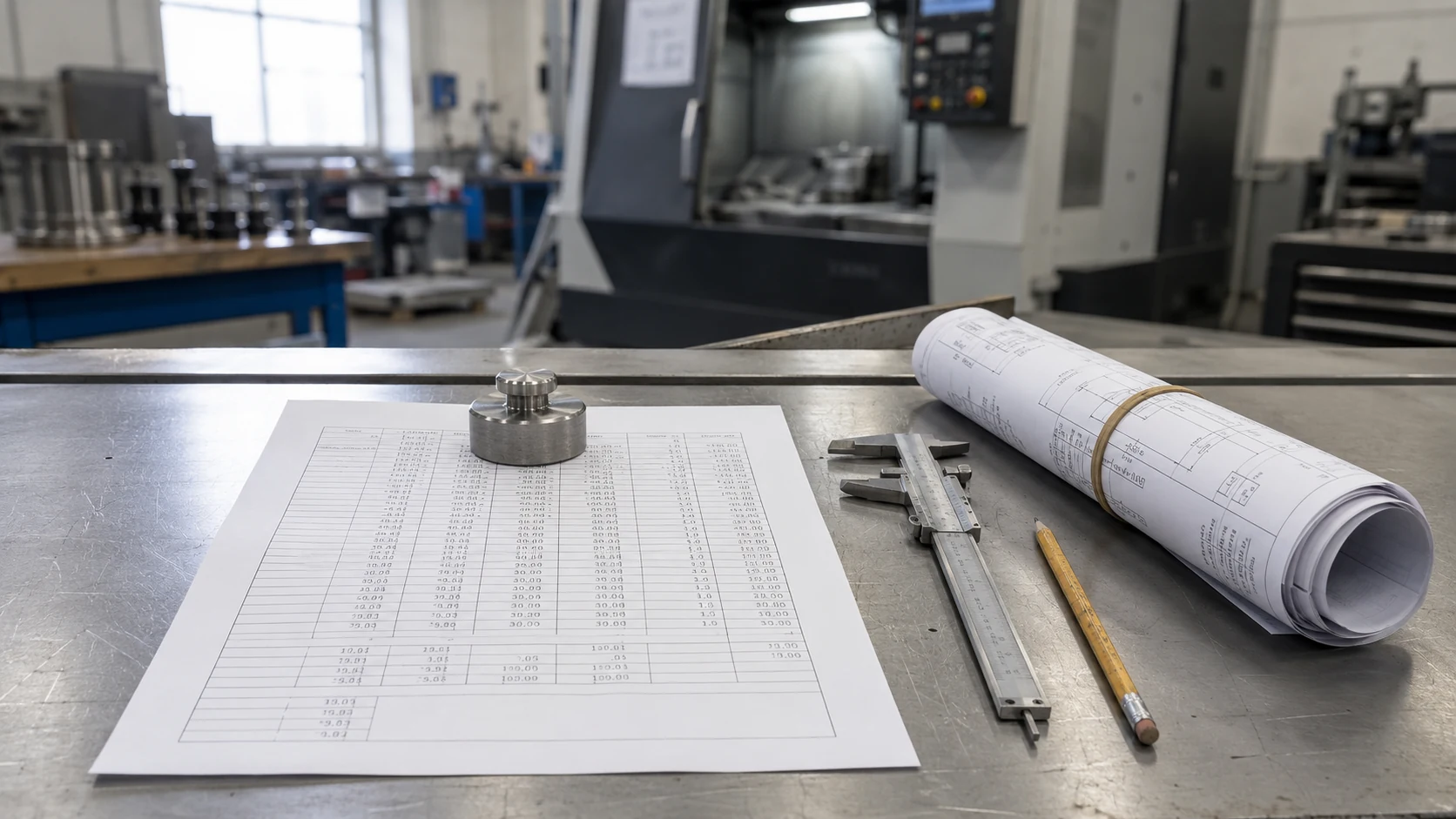
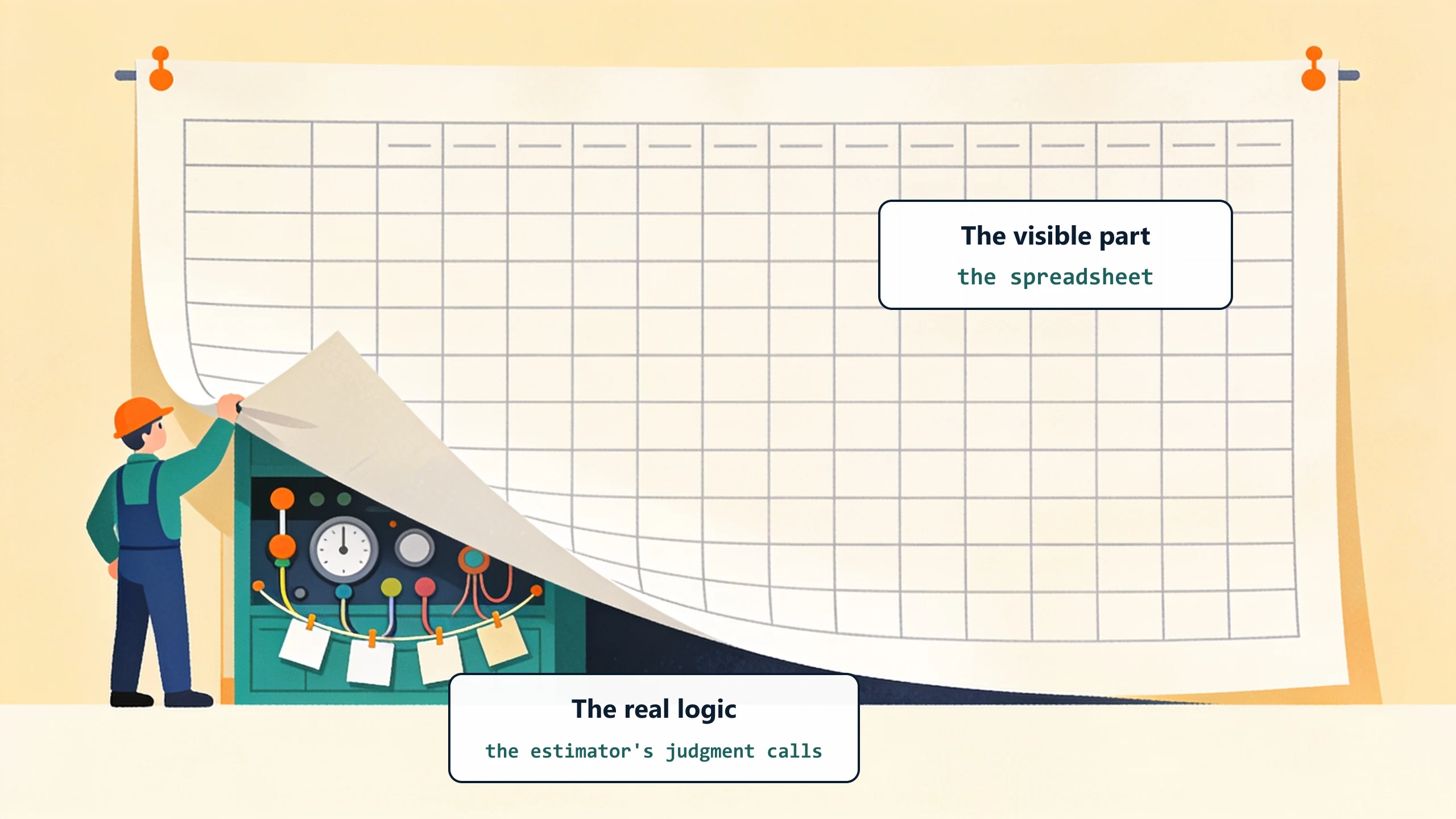
If you run a 10 to 50 employee manufacturing shop and your quoting still happens in Excel, you are in good company. Most small shops do. The question is whether you are losing more business to slow quotes than you would lose to the cost of replacing the spreadsheet. We spend the opening week of a quoting build sitting with the estimator, and what we learn every time is that the spreadsheet is only the visible part: the real pricing logic is the call they make on the odd job, the margin they shave for a repeat customer, the surcharge they add when a tolerance looks tight. That judgment, not the file, is what you are deciding whether to leave trapped in one head.
When Excel quoting is still the right answer
Stay on Excel if all four of these apply:
- You quote fewer than 5 jobs per week.
- The estimator who owns the spreadsheet is not your bottleneck (they have spare capacity).
- Quote turnaround time is not affecting win rate (you are winning the bids you should win).
- Your pricing logic is stable (does not change quarterly with material costs or contract terms).
If all four apply, your Excel-based process is fine. Custom software will not pay back. Spend your money elsewhere.
The four signs that Excel quoting is the wrong answer
Four signs separate a spreadsheet that still works from one that is costing you jobs. Each one shows up in a different corner of the shop.
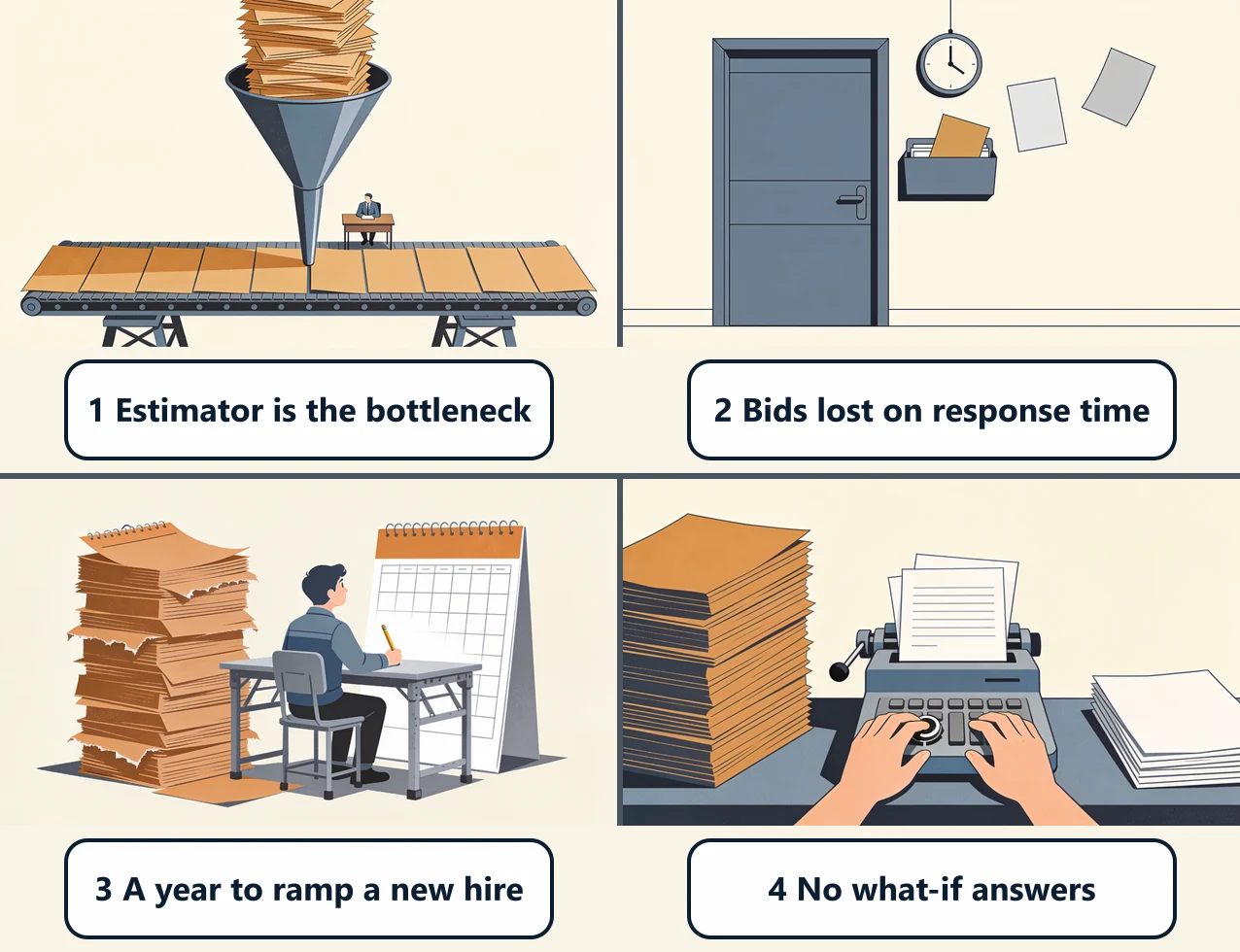
Sign 1: Your estimator is the bottleneck
Bids back up. RFQs sit for days. The estimator works evenings to keep up. They have not taken a real vacation in years. When they are out, the shop slows.
This is the single clearest sign. The estimator's experience is locked in formulas and judgment that cannot be replicated by a junior or a new hire. The shop's quoting capacity is bounded by one person.
Sign 2: You are losing winnable bids on response time
You hear back from a customer that they went with another shop because that shop responded faster. Or you suspect it but cannot prove it. In commercial manufacturing, response time and win rate are correlated tightly. Faster bids win more often.
The Excel-based quote takes 3 to 8 hours of estimator time. A custom quoting tool reduces that to 30 to 90 minutes for the same shop. The shops that responded in hours instead of days are the ones winning the work.
Sign 3: New hires take a year to ramp
You hire an estimator. They learn for 12 months before they can quote independently. The reason: the spreadsheet's logic is institutional knowledge that lives in your senior estimator's head. A custom tool that encodes the logic explicitly cuts that ramp time to weeks.
Sign 4: You cannot model "what if" scenarios
The owner asks: "What would our margin look like if material costs go up 8 percent?" The estimator has to rebuild a sample of recent jobs by hand. Two days later, you have the answer. By then the question has moved on. Custom software with the pricing logic encoded answers this in real time.
What a real quoting system actually does
Two failures arrive early, well before the estimator becomes the bottleneck. Version drift: quote 47 came off a 2024 master template, quote 81 off a 2025 master that fixed a margin bug, nobody went back, and now three customers pay off three price lists for the same part. Formula decay: the cost-per-pound formula worked when raw stock came from one supplier, has been patched four times since, and the estimator quietly checks it on a calculator before trusting the answer. Neither is a discipline problem. Strip away the marketing and a quoting tool worth running has three jobs.
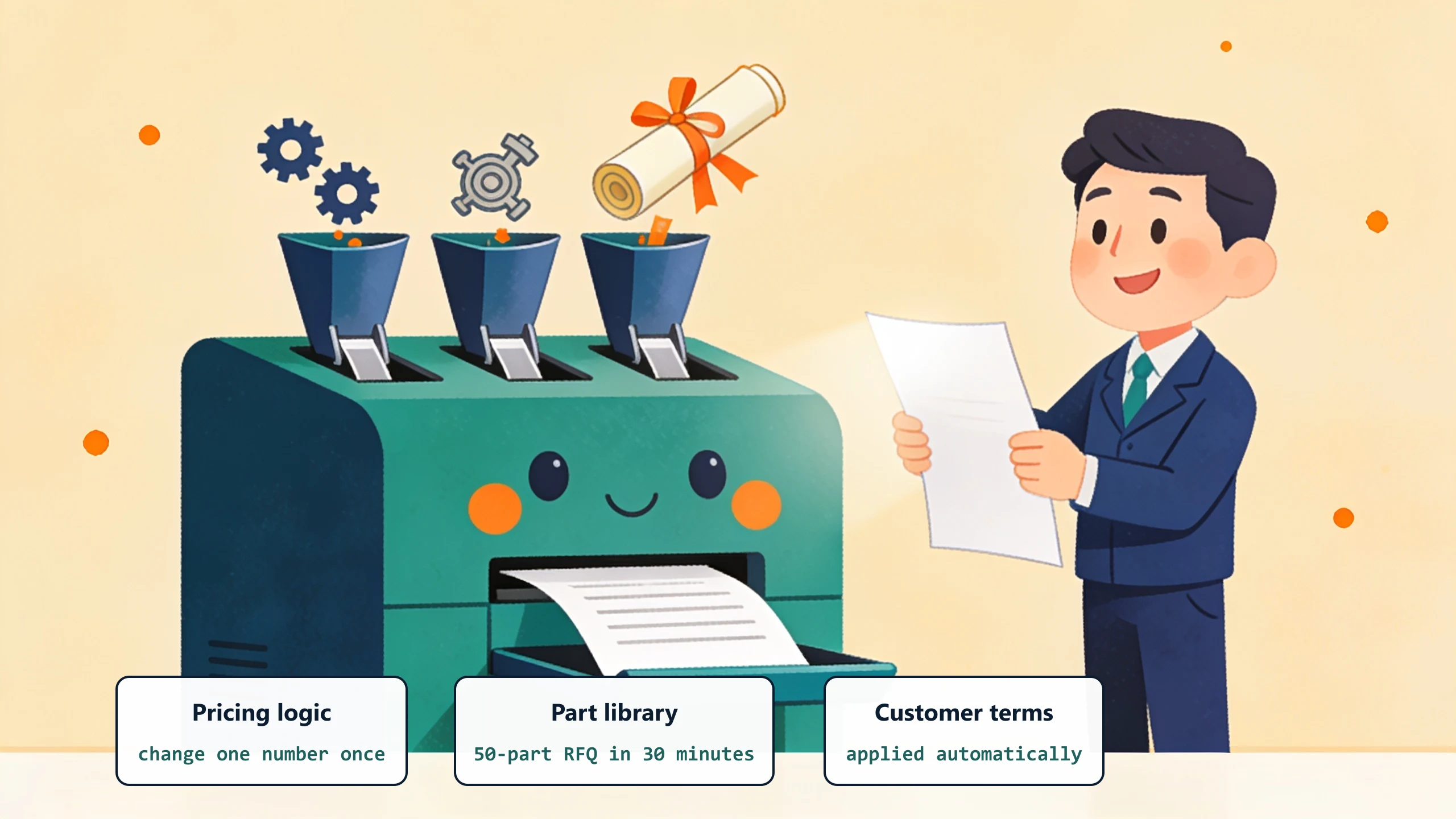
The pricing logic
Encoded once, applied consistently. Material cost, labor minutes, machine time, finishing, shipping, margin. When alloy prices move you change one number, and every active quote reflects it.
The part library
Reusable part definitions with their routings, materials, and standard times. New quotes pull from the library instead of being rebuilt from scratch. A 50-part RFQ becomes a 30-minute job, not a two-day job.
The customer terms
Each account carries negotiated terms: volume tiers, payment terms, kit pricing. The system applies them. The estimator stops having to remember which customer gets which discount.
What comes after Excel
Three options for a small manufacturer:
Option 1: Off-the-shelf manufacturing quoting platform
Examples: Paperless Parts, Estimator360, ShopXpert, Steelhead. $300 to $1,500 per month plus implementation. Works if your shop's pricing logic matches the platform's model. Most small shops do not match cleanly because their pricing logic is bespoke. If yours carries volume-tier kits, alloy surcharges, or customer-specific overhead, the implementation period becomes an exercise in bending the platform to fit.
Option 2: Project-based custom quoting tool from a dev shop
$25,000 to $75,000 build, 4 to 6 months, then maintenance is your problem. Works if you have a technical owner on staff who can absorb the post-launch maintenance.
Option 3: Custom-plus-managed quoting tool (the model ByteQuix uses)
A one-time pilot fee in 1 to 3 weeks. Then a flat monthly fee. Maintenance and refinements included. Built around your specific pricing logic, your part library, your customer-specific contract terms, your estimator's edge cases. See our mold-shop quoting tool case study for a real example.
Weeks one and two turn the estimator's live RFQs into the rules behind the tool: which surcharge applies, when a quantity break kicks in, why one customer carries a different overhead number. By day 30 those rules run underneath one input form, and the estimator checks what the tool returns instead of re-typing the same math.

The break-even math
For a typical 30-person fabricated-metal shop:
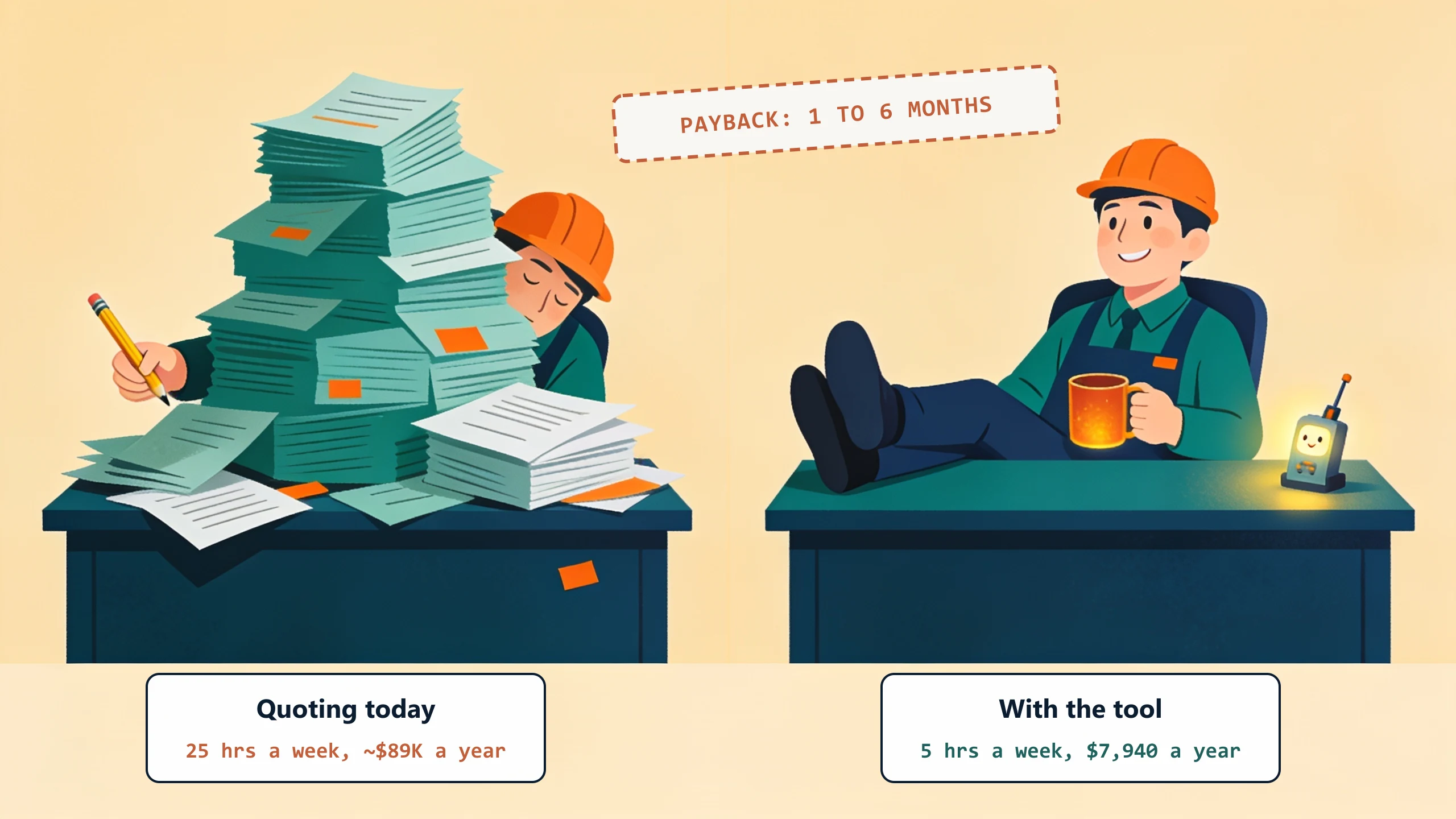
- Estimator time on quoting: 25 hours per week. Fully-loaded cost: $50/hour. Annual: $65,000.
- Lost business from slow quotes: estimated 5 percent of bids that should have won. On $4M in annual revenue with a 12 percent win rate baseline, that is $24,000 in additional revenue per year.
- Total current annual cost: ~$89,000.
- Custom-plus-managed Growth tier annual: a one-time pilot fee in year one, then a flat monthly fee, lower again from year two onward.
The custom alternative reduces estimator time to 5 hours per week (40 weeks of capacity recovered) and improves win rate, well against the ~$89,000 current annual cost. For most shops the tool pays for itself well inside a year.
What to do this week
Walk over to your estimator's desk. Ask them: "If you could only quote 5 jobs this week with the current process, which 5 would you pick?" Their answer reveals which jobs are most underserved by the current process. Those are the candidates for the custom tool's first iteration. Walk us through the answer on a free 30-minute discovery call.
No pitch, no pressure. We diagnose, you decide.
Have a question? We reply by email, no call needed.