

When a small-business owner asks "how much does custom software cost," they are usually told either "it depends" or a five-figure number with no breakdown. Both answers are useless. Here are real ranges across the actual delivery models, so you can pick the one that fits your situation.
The five delivery models for custom internal tools
Almost every custom software project for an SME falls into one of five categories. The price ranges below are 2026 numbers, US-based, for a workflow specific to a 10 to 50 employee business (single team, one or two integrated systems, not a full platform replacement).
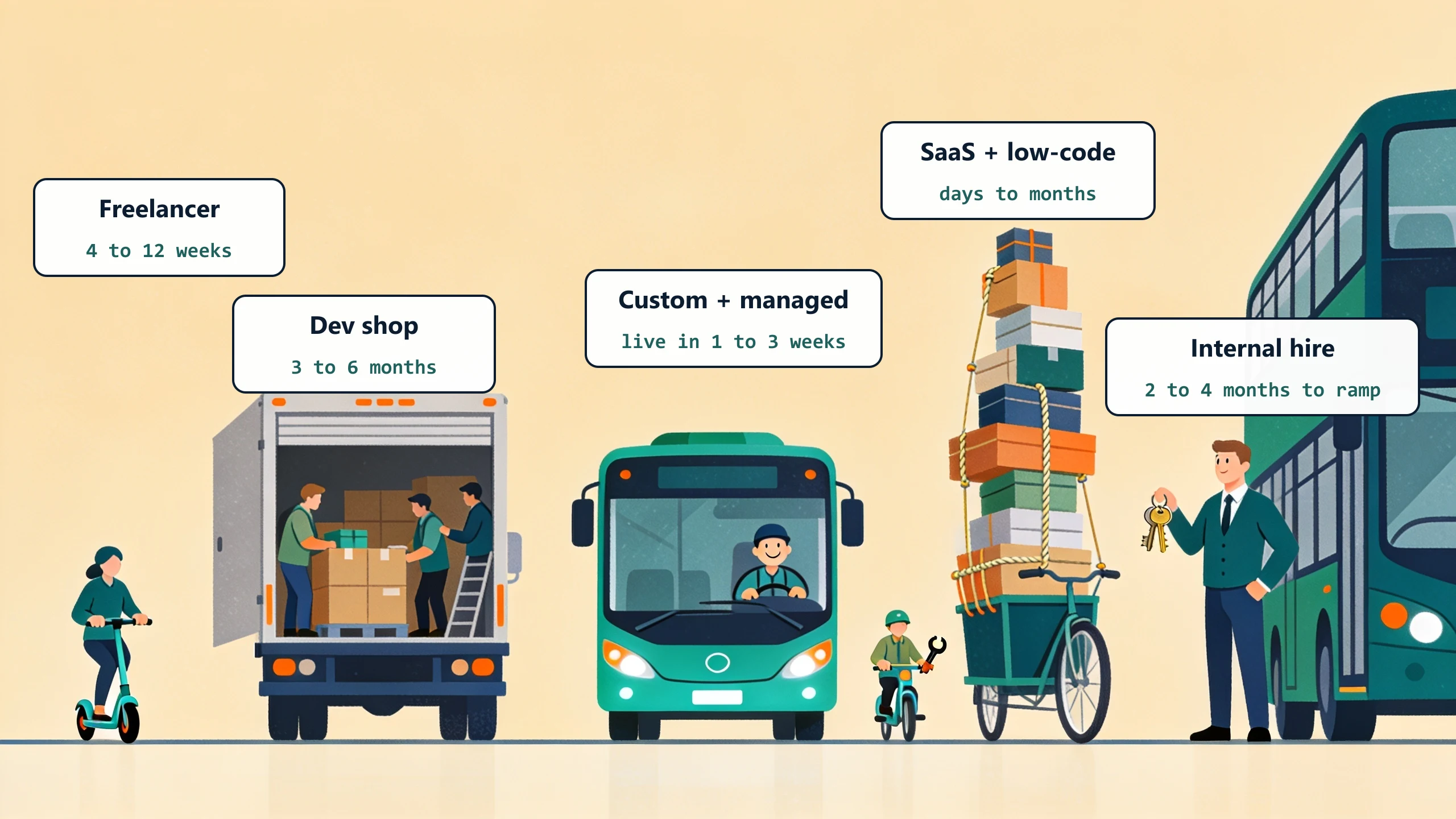
1. Hire a freelancer
Price: $50 to $150 per hour. Total project: $5,000 to $25,000 depending on scope.
Timeline: 4 to 12 weeks.
What you get: One person builds the tool. Probably ships. Quality depends entirely on the freelancer.
What can go wrong: The freelancer disappears mid-project (common). Or the tool ships but nobody can maintain it because only the freelancer understands how it works. Or the scope balloons because there is no second pair of eyes catching scope drift.
Who this fits: Businesses with a technical owner or technical operations person who can supervise the freelancer and own the tool after launch. If you do not have that person, this is the riskiest of the five models.
2. Project-based dev shop
Price: $25,000 to $75,000 typical for one workflow. Larger projects scale up from there.
Timeline: 3 to 6 months.
What you get: A team builds the tool. Better quality bar than a freelancer. Documented handoff. The dev shop typically walks away on a defined date.
What can go wrong: The handoff is real. Six months after launch, an integration changes, the tool breaks, and you are paying $150 per hour for change orders or for an "ongoing support" retainer that often does not actually cover what you need. The maintenance cliff is real.
Who this fits: Businesses with budget and time, building something that they expect not to need to change for years. Rare for SMEs.
3. Custom-plus-managed (the model ByteQuix uses)
Price: a flat monthly fee after a one-time pilot.
Timeline: 1 to 3 weeks for the pilot. 30 days live to validate. Continuous after that.
What you get: A team builds the tool around your specific workflow. Hosting, monitoring, maintenance, refinements, and small changes are included in the monthly fee. The team stays on the hook to keep it working.
What can go wrong: Less than the other models, but you are betting on the vendor staying in business. The model only works at scale; if your vendor is the wrong fit (too small, too new, financially shaky), the managed-service promise is only as good as the vendor.
Who this fits: Most 10 to 50 employee businesses with one specific bridging or workflow problem. Bounded cost. Bounded timeline. Predictable monthly spend. No maintenance cliff.
4. Off-the-shelf SaaS plus a low-code platform
Price: $200 to $1,200 per month for the SaaS, plus $50 to $1,500 per month for the low-code platform (Zapier, Make, n8n, Workato), plus the salary cost of whoever maintains the integrations (often $5,000 to $20,000 per year of attention).
Timeline: Days to weeks for simple flows. Months and ongoing for complex flows.
What you get: A configured rather than built solution. Owned and maintained by your team or a consultant.
What can go wrong: Hits the complexity ceiling we talked about in the Zapier post. Maintenance creeps. The "platform" turns into another bespoke tool nobody fully understands.
Who this fits: Businesses with a workflow that genuinely matches a popular SaaS, with light bridging needs.
5. Internal hire
Price: $90,000 to $150,000 fully loaded for a US-based developer. Salary plus benefits plus tools plus management overhead.
Timeline: 2 to 4 months for the hire to ramp. Continuous after that.
What you get: A developer on staff. Tools owned in-house.
What can go wrong: One developer cannot cover frontend, backend, infrastructure, security, and integrations all at once. They will be lonely. They will leave within 18 months on average. The institutional knowledge leaves with them.
Who this fits: Businesses with enough sustained need to keep a developer continuously busy on bespoke work. Rare under 50 employees.
The five-year comparison
For an SME with one specific workflow problem, the five-year cost separates the models far more sharply than the build price does.

- Freelancer: $15,000 (build) + $5,000 to $30,000 (ad-hoc maintenance) = $20,000 to $45,000.
- Project-based dev shop: $50,000 (build) + $24,000 to $60,000 (5 years of retainer) = $74,000 to $110,000.
- Custom-plus-managed: a one-time pilot fee plus five years of a flat monthly subscription at the relevant tier.
- SaaS plus low-code: $30,000 to $90,000 in subscriptions over 5 years, plus the salary cost of the maintainer.
- Internal hire: $450,000 to $750,000 over 5 years (assuming the developer stays).
Custom-plus-managed and freelancer are the cheapest models on paper. The freelancer model has higher variance because of disappearance risk and maintenance-cliff risk. The custom-plus-managed model has lower variance because maintenance is contractual.
What this looks like at ByteQuix specifically
ByteQuix runs the custom-plus-managed model as a 30-day pilot (one Tool, scoped before we start, with a defined success metric), then a flat monthly fee once the pilot proves out. The Starter tier covers 3 active Tools and 5 users, Growth covers 5 Tools and 10 users, and Scale covers 8 Tools and 25 users. Hosting, monitoring, maintenance, and refinements are included at every tier.
What is not included: net-new Tools beyond your tier count, integrations into systems we do not already cover, and major feature additions or redesigns. Those are scoped separately as a fixed-fee project.
The model works because we run multiple clients on the same platform infrastructure. The custom part is the workflow. The platform underneath is shared. That is how the math pencils for an SME on a flat monthly fee.
The reason a build lands in 1 to 3 weeks instead of months is that we are not building a platform. We watch where one specific workflow hurts, the spreadsheet or the copy-paste step, and build only that, then run it live for 30 days against an outcome agreed up front. When the usage proves out, it moves onto the Starter tier without a second negotiation. Book a free 30-minute discovery call to size your pilot.
What to do this week
If you are evaluating models for a specific workflow, start by sizing the problem. Get out a notebook and write down: how many hours per week does the broken workflow currently consume, and at what fully-loaded hourly cost? Multiply by 50 weeks. That number is your annual ceiling for what fixing this is worth.
If the answer is under $5,000 per year, do not build custom software. Hire a Zapier consultant or live with it. If the answer is between $5,000 and $30,000 per year, custom-plus-managed is almost always the right model. If the answer is over $30,000 per year, you have multiple paths and a more careful analysis is warranted.
To walk through your specific number with us, book a free 30-minute discovery call. We will run your number, not a template. Sometimes it comes back saying do not build.
No pitch, no pressure. We diagnose, you decide.
Have a question? We reply by email, no call needed.