

For a $5 to $20 million commercial subcontractor, the construction-software market is not built for you. Procore targets general contractors above $50 million. Buildertrend targets residential. The middle is a no-mans-land of half-fitting tools, manual workarounds, and Excel where the software fails. The better move is to pick the two or three jobs that need software the most and stop trying to fit a platform that wants to be the system of record.
The platform-vs-point-tool decision
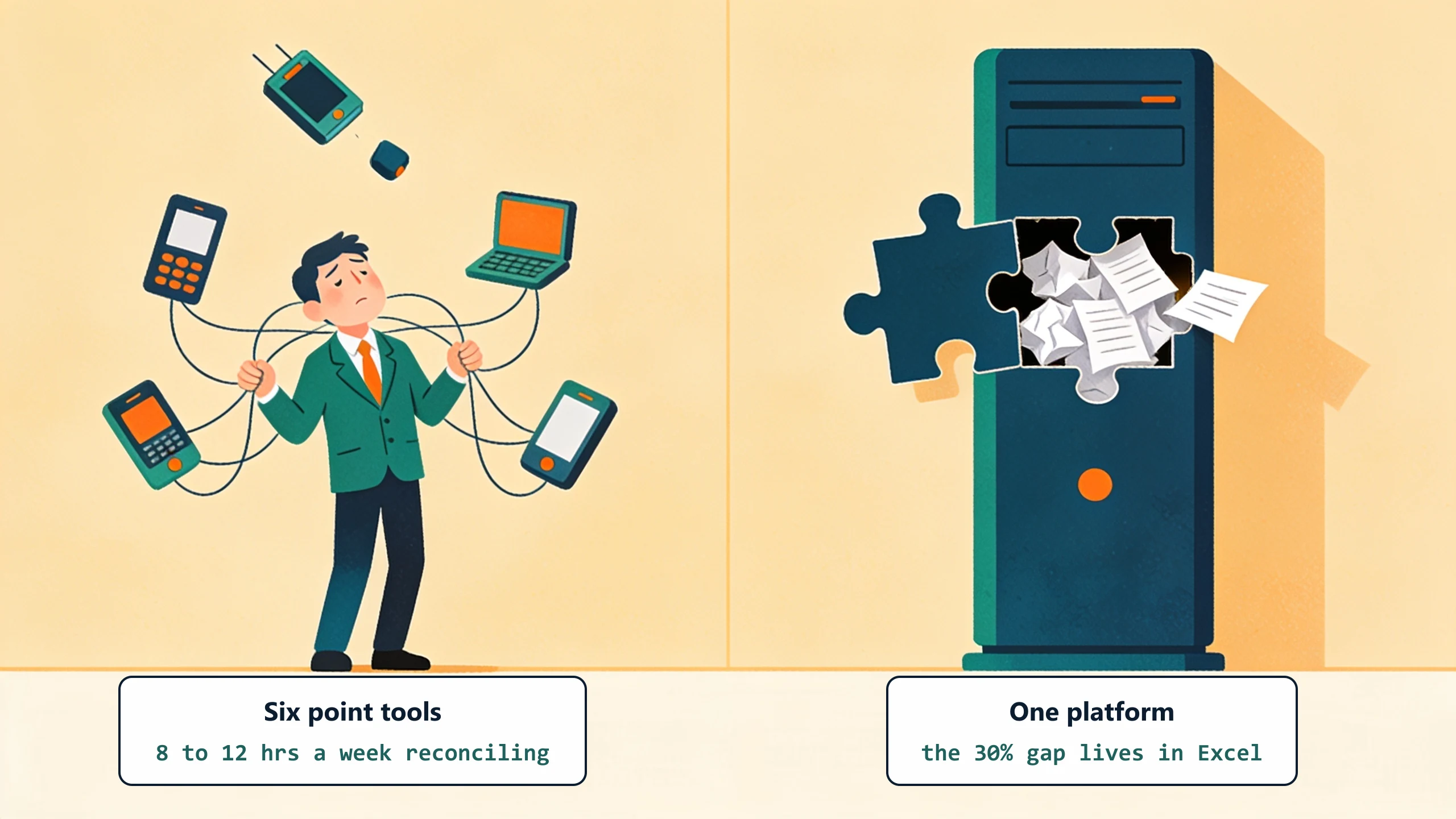
Most small commercial contractors carry one of two stack shapes. Either six disconnected tools and a project manager who reconciles them by hand, or one platform that does 70 percent of the job and 30 percent that the team works around in Excel. Both are stable. Both are expensive in different ways.
The platform stack
One tool (Procore, Sage 100 Contractor, or similar) covers project management, budgeting, RFIs, submittals, and (sometimes) job costing. Costs $30,000 to $100,000 per year for a small contractor. The 30 percent gap is usually around the way your shop handles AIA billing, schedule of values, or specific subcontractor coordination. The team patches it with shared spreadsheets.
The point-tool stack
QuickBooks for accounting, BuilderTrend or CoConstruct for project tracking, a separate tool for daily logs, a fourth for time clocks, a fifth for submittal tracking. Each is cheap. The total bill is $1,500 to $4,000 per month and a project manager spends 8 to 12 hours a week reconciling between them.
The four jobs that actually move the needle
For a small commercial contractor, four operational jobs cost the most when they go wrong. These are the candidates for either custom or higher-quality off-the-shelf tools.
AIA progress billing
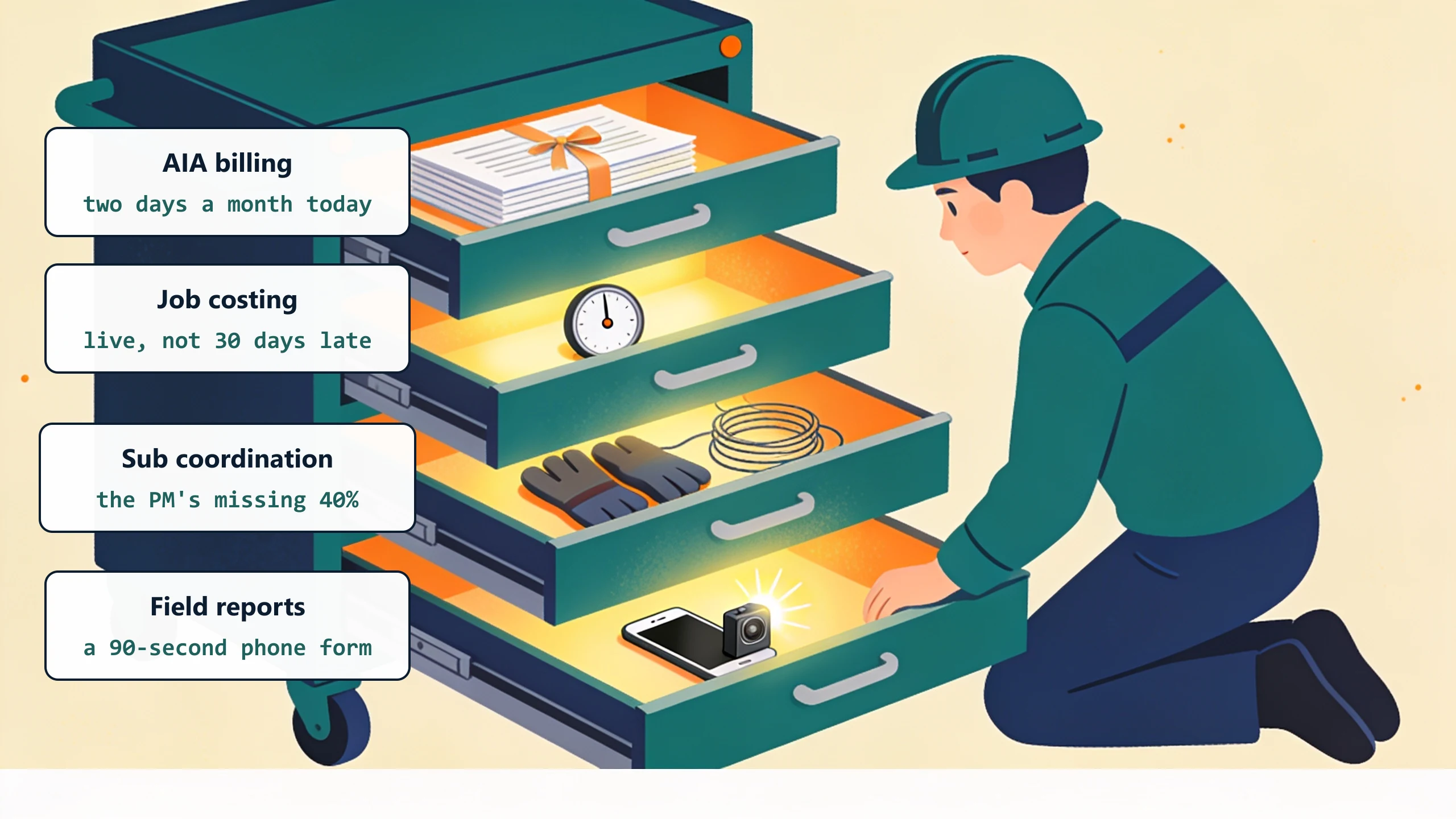
Schedule of values, percent complete, retainage, change orders. AIA G702 and G703 forms. If billing takes two days a month and creates a back-and-forth with the GC, that is the job. The math on time saved alone usually justifies a custom or hybrid solution at this scale. Underneath the billing math sits a leak we keep finding at closeout: signed change orders and finished scope wait in a folder for weeks before they become an invoice, so a profitable job reads as a thin one until the paperwork catches up.
Job costing in real time
Knowing today which jobs are on budget, which are bleeding labor, and which are over on materials. Most platforms claim this and deliver it 30 days late. The shops that have it right have a custom layer that pulls QuickBooks costs, foreman time entries, and PO commitments into a single dashboard the PM looks at every morning.
Subcontractor and supplier coordination
POs, COIs, lien waivers, scope-of-work tracking. The coordination is per-trade and per-project. A platform handles 60 percent. The other 40 percent is where the project manager's time goes.
Daily field reports
Foreman in the truck, photo with timestamp, weather, headcount, work performed, issues. The right tool here is a phone-first 90-second form. Anything more complicated does not get filled out.
What a custom-plus-managed approach looks like
Build the AIA billing tool and the real-time job-cost dashboard around your existing QuickBooks. Keep using the field-tool you already pay for if your foremen are trained on it. Build the integration layer that closes the 30 percent gap on the platform you already have, instead of replacing the platform. Pricing: a one-time pilot fee, then a flat monthly fee. The custom integrations sit alongside your existing stack, not on top of it.
What to do this week
Pull your last three months of AIA billings. Count the back-and-forth emails per billing. Pull your last six months of completed projects. Count how many came in within 5 percent of budget. Those two numbers tell you whether the bottleneck is billing process or job cost visibility. Bring them to a free 30-minute discovery call and we will scope a custom layer if the math works.
No pitch, no pressure. We diagnose, you decide.
Have a question? We reply by email, no call needed.