

If you are an SME owner who has bought three SaaS tools to do one job, this is for you. The category most people call "SaaS replacement" is not really about replacing software. It is about choosing software that fits your business instead of bending your business to fit the software. The decision is simpler than the marketing makes it sound. Nine times out of ten, the problem we are called in to fix is not a broken tool at all. It is a person on the payroll wedged between two screens, hand-carrying numbers from one to the other because neither tool was built for the way the business actually works.
Three questions before any vendor pitch
Before any vendor pitch, run your situation through three questions. If you answer yes to all three, custom software is likely the right call. If you answer no to any of them, fix the off-the-shelf SaaS first.
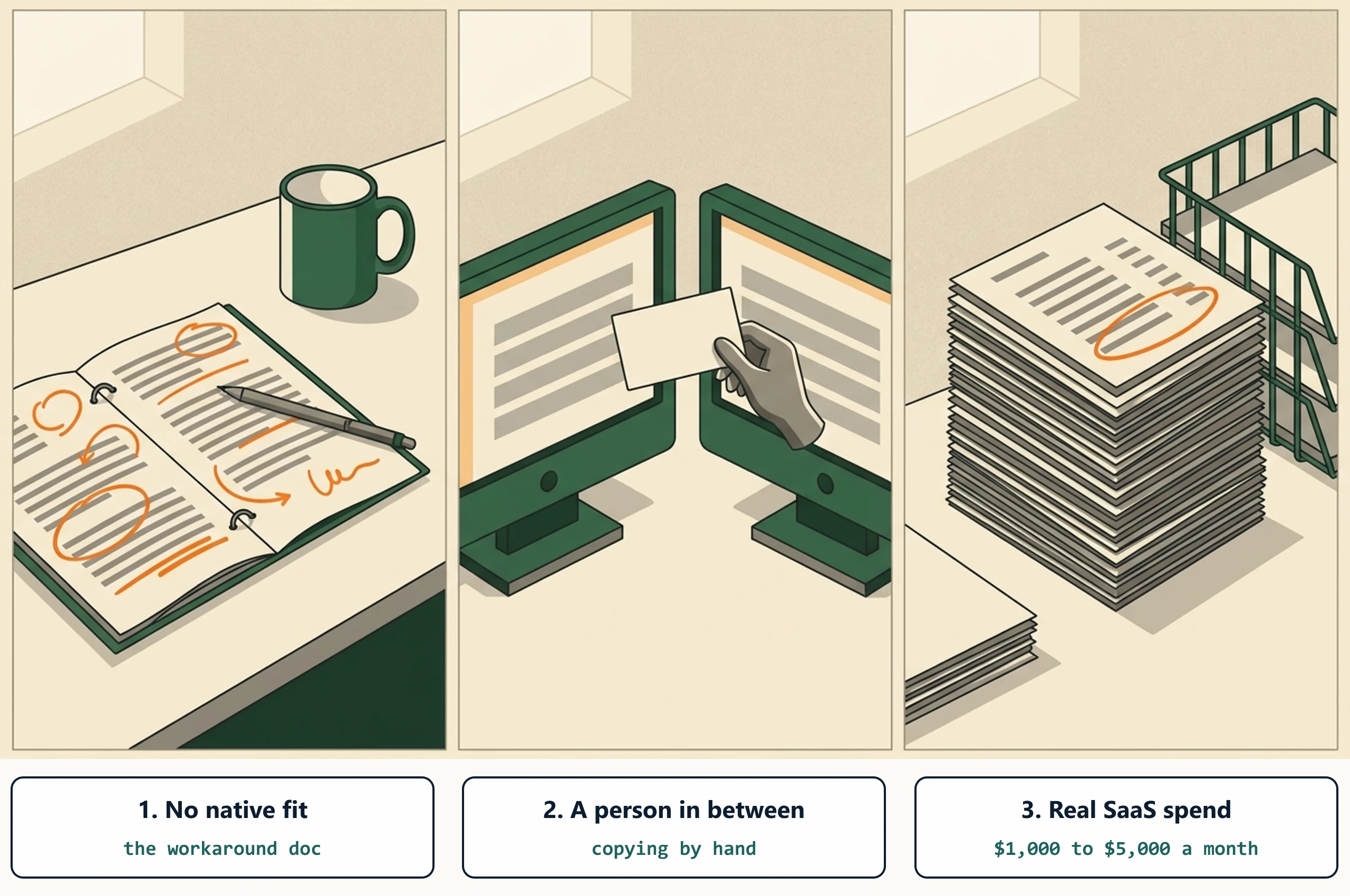
1. Are you running a workflow that the SaaS does not natively support?
Every SaaS has a happy path. The product was designed around a particular sequence of actions, owned by a particular role. If your shop does it differently (and most SMEs do something differently), you are paying for a tool that fights you. The tell: your team has a "workaround document" that explains how to use the tool the way your business actually works. Two pages of workaround per tool is a strong signal you are bending your business to fit the SaaS.
2. Are you paying a person to bridge two systems by hand?
The most expensive SaaS is the one that requires a human to copy data from System A to System B every week. The salary cost of that bridging is almost always larger than the cost of the SaaS itself. Quoting in a CRM and re-typing into QuickBooks for billing. Capturing time in a project tracker and re-entering it for payroll. Pulling reports from one system and pasting them into a board deck. Every "and then someone copies it over" step is a candidate for software.

3. Is the SaaS expensive enough that custom software pencils?
If your current SaaS bill (across all the tools that touch the broken workflow) is under $200 per month, custom software is rarely the right move. The math does not work. But if you are spending $1,000 to $5,000 per month on SaaS to support a workflow that still has a person in the bridge role, custom software almost certainly does pencil. The threshold to watch is total annual SaaS spend on a single workflow approaching the cost of a year of managed custom software (roughly $3,500 to $11,000 depending on tier).
What "custom software" actually means in 2026
Five years ago, custom software meant a six-figure project from a dev shop, a six-month timeline, and a year of regret when the dev shop walked away. That is still available. It is no longer the only option.
The newer model is custom plus managed. Someone builds the tool around your specific workflow, runs it on infrastructure they manage, and includes maintenance, refinements, and small changes in a flat monthly fee. The build window collapses to weeks instead of months because the goal is one specific workflow, not a platform replacement. The total cost of ownership is bounded because there is no separate maintenance contract.
This is the model ByteQuix uses. A handful of regional custom-software shops offer something similar under different framing. The competitive advantage of the small custom-plus-managed builder is that they can model your specific workflow and ship faster than a SaaS vendor can configure their product to match. The competitive disadvantage is that you have to trust them to keep running it, which is what the managed-service contract is for.
Real numbers
Price one broken workflow over a full year, for an SME where data flows between two systems and a person sits in the middle, and the three available paths are not close.
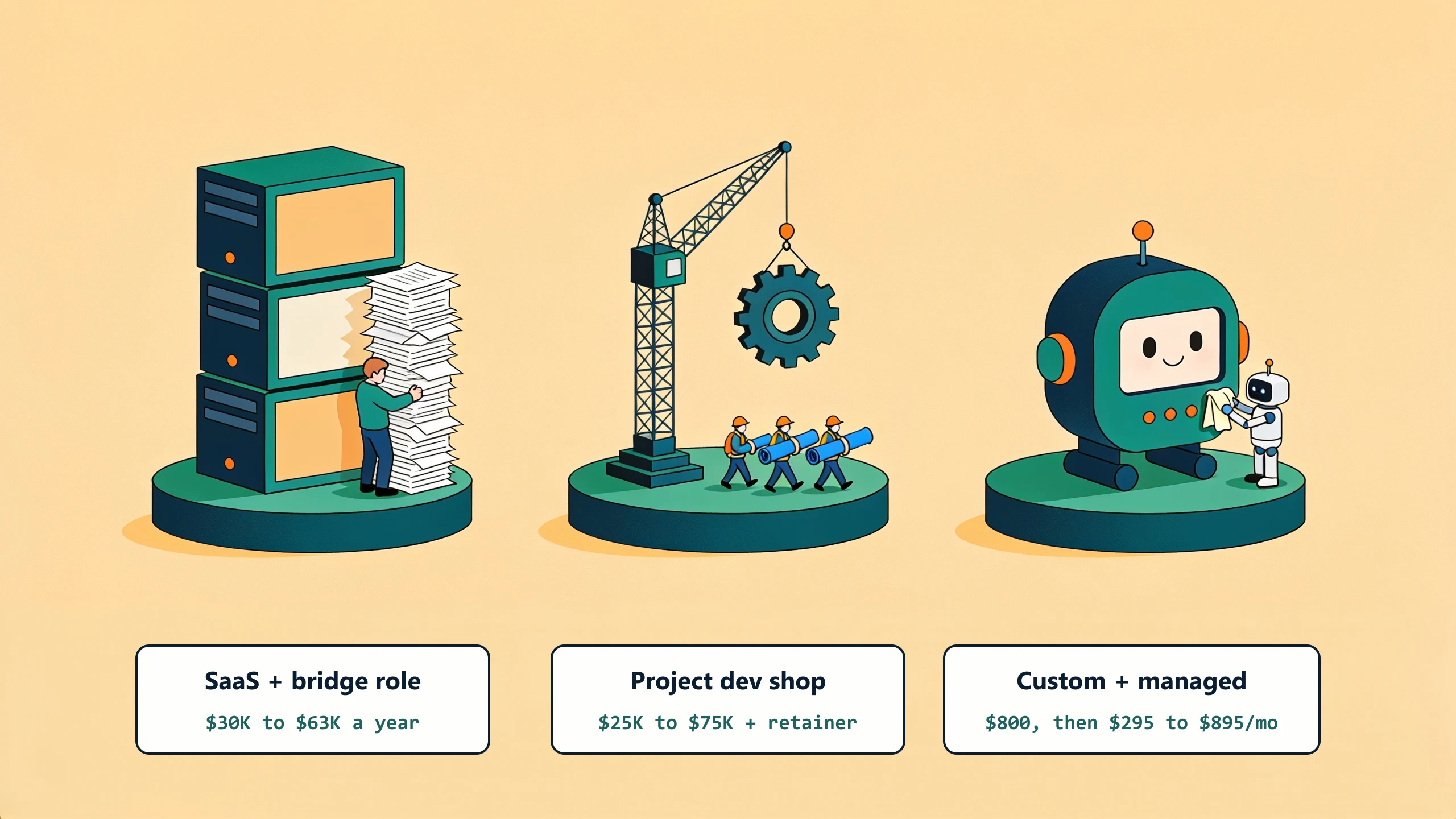
- SaaS path: $400 to $1,500 per month for the SaaS, plus the salary cost of the person in the bridge role (roughly $25,000 to $45,000 fully loaded, even at 15 hours per week). Total annual cost: $30,000 to $63,000. Workflow still has a person in the bridge.
- Project-based dev shop: $25,000 to $75,000 upfront. 4 to 6 month build. Maintenance contract optional, often $500 to $2,000 per month after launch. Risk: if the workflow needs to change, you are paying $150 per hour for a developer who left the project.
- Custom plus managed: a one-time pilot fee for a 30-day proof of value, then a flat monthly fee including hosting, monitoring, maintenance, refinements, and small changes. The bridge role goes away. The vendor stays on the hook to keep it working.
For most SMEs with one specific bridging problem, the custom-plus-managed math is the cleanest. You stop paying for the bridging role, you stop paying for the SaaS that did not quite fit, and the workflow becomes part of how you run the business instead of a tax on it.
What to do this week
If you are sitting on a SaaS bill that has crept past $1,000 per month and a workflow that still requires a person to bridge two systems by hand, the next step is to figure out which one of those workflows is costing you the most. Two ways to do that:
- Spend an hour with a notebook and write down the top five repeated tasks that involve copy-paste between systems. Estimate hours per week and who does it. Multiply by their fully-loaded hourly cost. The biggest number is your candidate.
- Or start from a free SaaS audit: a one-page map of your subscription stack that surfaces the overlapping and underused tools hiding in it. It is the fastest way to see which workflow is worth fixing first.
Either way, the answer to "should I replace SaaS with custom software" is rarely "yes, replace everything." It is almost always "yes, replace this one specific workflow that has been bleeding hours for years." Find that workflow first. The rest follows.
If you want to walk through your specific situation with us, book a free 30-minute discovery call. We do not pitch unless we are confident we can help. Most calls end with one of three answers: "this is a fit, here is the pilot," "this is a fit but timing is off, call us in six months," or "this is not a fit, here is who you should call instead."
No pitch, no pressure. We diagnose, you decide.
Have a question? We reply by email, no call needed.