

"Managed software service" is a new category. It does not yet have a clean Wikipedia entry. If you are a small-business owner trying to understand the difference between this and a SaaS subscription or a dev-shop project, this is the primer.
The two-sentence definition
A managed software service is a custom-built piece of software that the vendor designs around your specific workflow, then operates on your behalf for a flat monthly fee. The custom part is the workflow. The managed part is everything required to keep that workflow running, including hosting, monitoring, maintenance, security, refinements, and small changes. Most of what we actually do for a client lands here, after the build ships: the 1 to 3 weeks of building is the short stretch, and the months of hosting, watching, and refining the running tool are the long one. Owners picture the build as the work. For us it is the opening move, and the managed operation is where the value compounds.

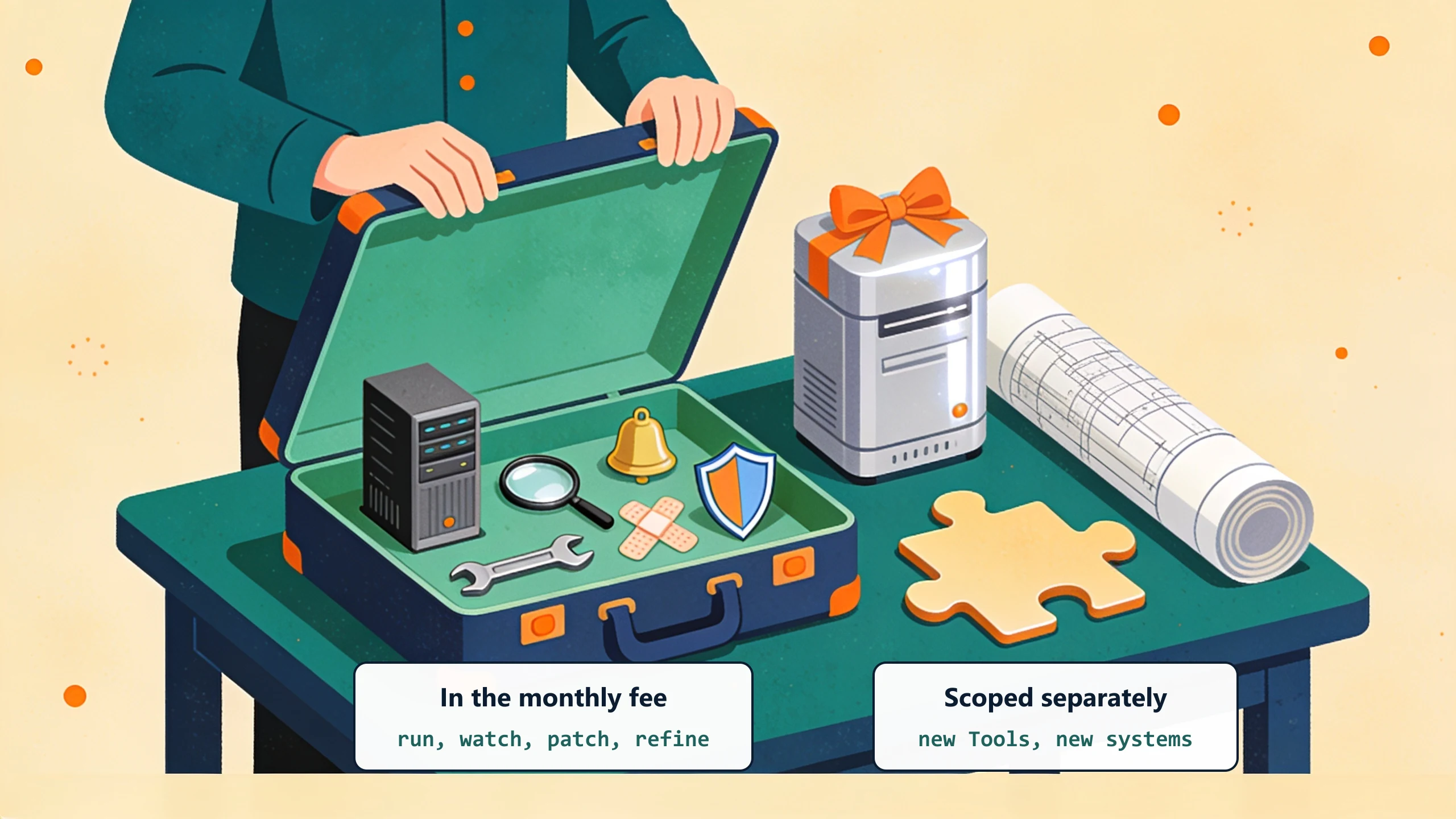
The deliverable: what is included, what is not
What you get, in concrete terms
For an SME commissioning a managed software service, the deliverable is roughly the following. Numbers and inclusions vary by vendor, but the shape is consistent across the category:
- One or more custom Tools. Each Tool solves one specific workflow problem. A custom quoting tool. A customer-portal layer on your existing rental system. A daily reconciliation between your TMS and your QuickBooks. Tools are bounded; they do one thing well.
- Hosting and infrastructure. The vendor runs the Tools on their cloud infrastructure. You do not manage servers or pay for AWS separately.
- Monitoring. The vendor watches for failures, slowdowns, and anomalies. They tell you when something is wrong before you find out from a customer.
- Maintenance. When the SaaS API your Tool integrates with changes (and it always does), the vendor updates the Tool. You do not.
- Security. Patches, dependency updates, vulnerability monitoring. Standard stuff that needs continuous attention.
- Included refinements. Small changes you ask for. New fields, layout tweaks, a different sort order, a new alert. Capped at a fair monthly hour budget but typically well over what most clients use.
- Bug fixes. Within agreed response times.
- Monthly KPI reporting. A short report showing what your Tools did this month, how often they ran, what they saved.
What is not included
Most managed software services explicitly do not include:
- Net-new Tools beyond your tier. If your tier covers 3 active Tools and you want a 4th, that is a new scope conversation.
- New integrations into systems the vendor does not already support. Adding a brand-new ERP integration mid-flight is project work, not maintenance.
- Major feature additions or redesigns. Reshaping the workflow into something materially different is also project work.
- Training your team. Some vendors include light onboarding; major training programs are typically separate.
- Strategy consulting. Managed software service vendors are builders, not consultants. If you need help redesigning how your business works, hire a consultant.
Why the category exists
Three trends made this category practical in the last few years:
- Cloud infrastructure costs collapsed. Hosting the kinds of small custom tools SMEs need now costs $5 to $50 per month per tool. Five years ago that was $200 to $500.
- Code-generation tools matured. Building the bespoke workflow logic takes meaningfully fewer human-hours than it did in 2020. The savings show up as compressed build timelines (1 to 3 weeks instead of 3 to 6 months) and lower price points.
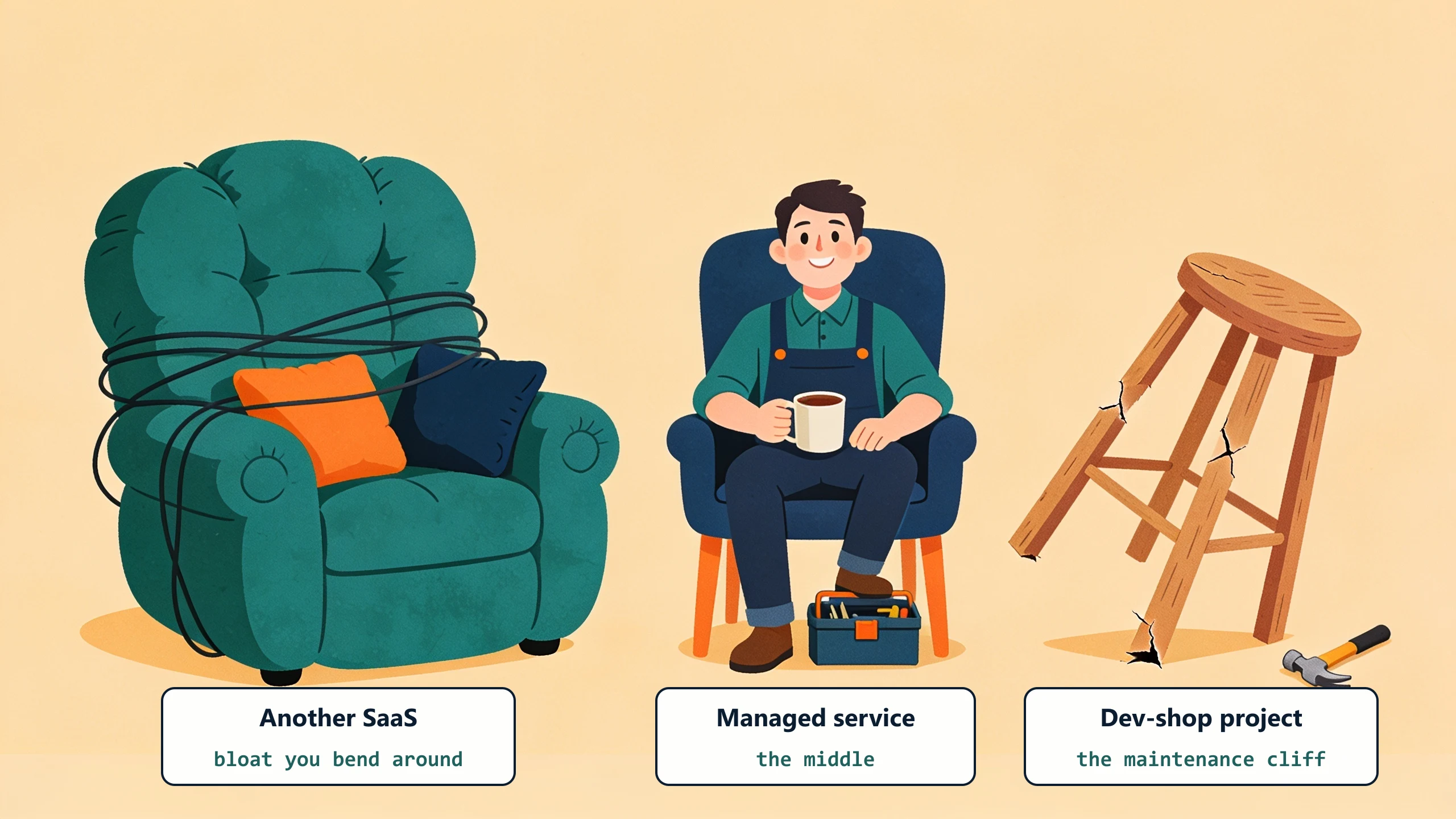
- Small businesses got fed up with SaaS bloat and dev-shop maintenance cliffs. The market was waiting for something between "configure another SaaS" and "hire a dev shop and pray." Managed software service is that middle.
Where it fits, where it does not
Managed software service fits when:
- You have a specific workflow that off-the-shelf SaaS does not match.
- You do not have a developer on staff and have no intention of hiring one.
- You want bounded, predictable spend instead of project bills.
- The workflow involves data that lives in systems you already have (an ERP, a QuickBooks, a CRM, a rental management system, a phone system).
- You are a small or medium business, where the math pencils.
It does not fit when:
- You need to replace a major system (an ERP, a CRM platform). Those are platform replacements, not workflow tools.
- Your workflow needs are genuinely standard and a SaaS already exists that fits well. Buy that SaaS.
- You have an internal development team. They can build it for you. Pay them.
- You need on-prem deployment. Most managed software services run in the vendor's cloud, by design.
How to evaluate a vendor
Five questions to ask any vendor in this category:
- What is your published pricing? If they will not give you a number until after a sales call, the model is not actually flat-fee managed. Walk away.
- What happens at month 13? Some vendors disguise project-based pricing as monthly fees that balloon at the renewal mark. The answer is "the same monthly fee."
- How many production Tools have you built across how many industries? A vendor with 17 production Tools across 9 industries has seen enough of these builds to know what works. A vendor with 2 production Tools is still finding their model.
- What is included vs scoped separately? A clear written list. If the line between included and project work is fuzzy, expect surprises.
- Where does my data live, and what happens if you go out of business? Both reasonable questions. Data residency, data export, and contingency planning should have clean answers, not handwaving.
What to do this week
If managed software service sounds like it fits your situation, the next step is finding a vendor that has built in your industry before. The same approach carries over, but vendors with relevant experience get to value faster.
If you want to talk with us specifically, book a free 30-minute discovery call. We are based in the Twin Cities, work US-only, and have built across the seven industries we list on the homepage. The call is a real diagnosis call, not a pitch. Some of those calls end with us pointing you at a product that already does the job.
No pitch, no pressure. We diagnose, you decide.
Have a question? We reply by email, no call needed.