
For a small business with one workflow worth automating, custom software in 2026 costs somewhere between a flat monthly subscription and $75,000 upfront, depending on the model. The range is real. The right number for your situation depends on three things: how complex the workflow is, who maintains the tool after launch, and what kind of vendor relationship you can sustain. Here are the actual numbers and the break-even math.
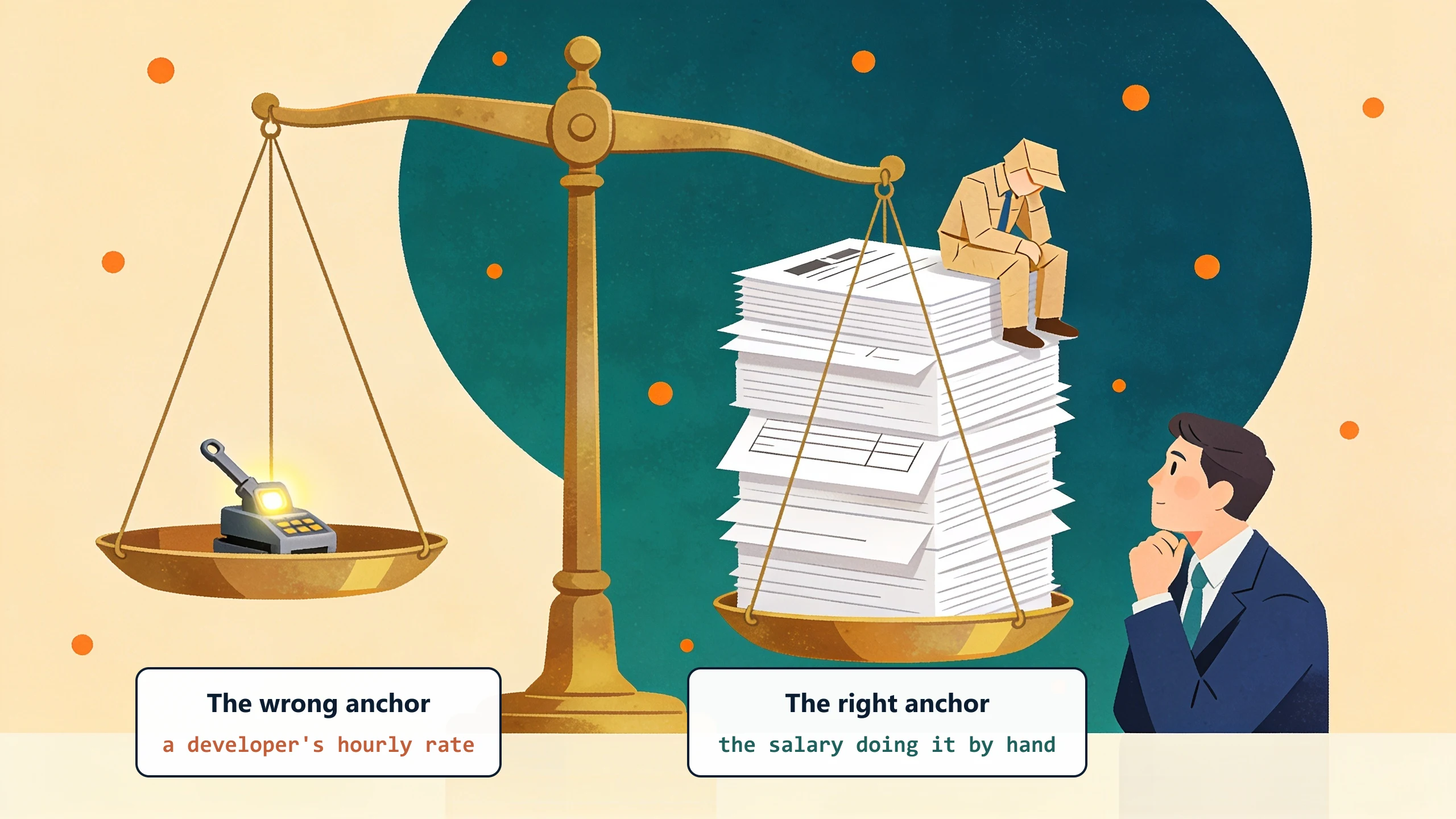
Price it against the salary you are already paying, not against a developer's hourly rate. The number that matters most is rarely the build cost; it is the fully loaded cost of the person currently bridging the gap by hand, because that is the line a working tool actually erases. We start every estimate from that figure, then work backward to whether a build pays for itself.
The three pricing models
Custom software pricing is not one market. It is three.
Project-based with a dev shop
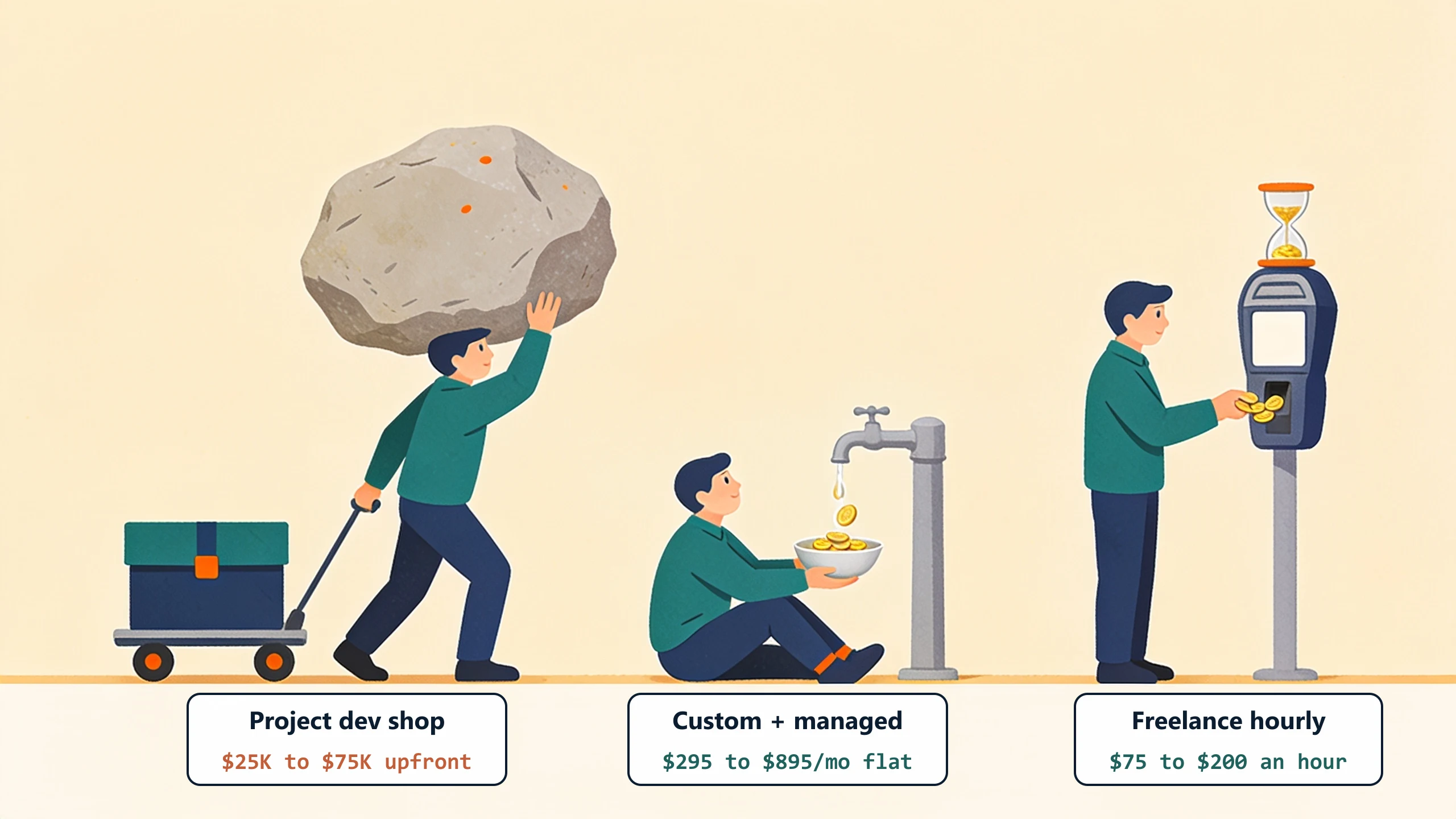
$25,000 to $75,000 upfront for a typical SMB workflow tool. Build window: 4 to 6 months. Maintenance after launch is your problem unless you sign a separate contract (usually $500 to $2,000 per month). The model fits if you have a technical owner-operator on staff who can absorb post-launch maintenance and small changes. Most small businesses do not.
Custom plus managed (subscription)
A flat monthly fee, including hosting, monitoring, maintenance, refinements, and small changes. Usually starts with a paid pilot for a working version against your real data in 1 to 3 weeks. The model that ByteQuix uses. Designed for SMBs that want a workflow tool without taking on the long-tail maintenance burden.
Per-developer freelance
$75 to $200 per hour for a freelance developer. Flexible. Risky. Works for small one-off scripts. Falls apart for anything that needs ongoing maintenance, because the developer eventually moves on and nobody can pick up where they left off.
What drives the cost up or down
Three factors set where in the range you land.
Workflow complexity
A quoting tool that takes part numbers and applies a pricing formula is a 1 to 2 week build. A quoting tool with customer-specific volume tiers, alloy surcharges, kit pricing, and a part library that pulls historical pricing is a 4 to 6 week build. Same category, very different number.
Number of integrations
Standalone tool with no external systems: cheap. QuickBooks integration: a known scope, manageable. Three integrations (QuickBooks, EDI provider, shipping carrier): triples the testing time and the failure modes. Each integration adds 1 to 2 weeks of build and ongoing cost in the maintenance fee.
Custom UI vs admin UI
An internal admin tool used by 3 people in your office: simple UI is fine. A customer-facing portal that handles your top 50 accounts: needs more polish, more testing, more security review. The difference can be 30 to 50 percent of the build cost.
Break-even examples
Three real-shaped scenarios for an SMB owner trying to decide.
HVAC shop with 8 techs, manual invoicing in the field
Cost of the manual process: 1 dispatcher at 12 hours per week chasing invoices, $35,000 fully loaded. Plus an estimated 5 percent of receivables aged past 60 days that get written off, on $1.5M annual revenue: $9,000 per year. Total: $44,000.
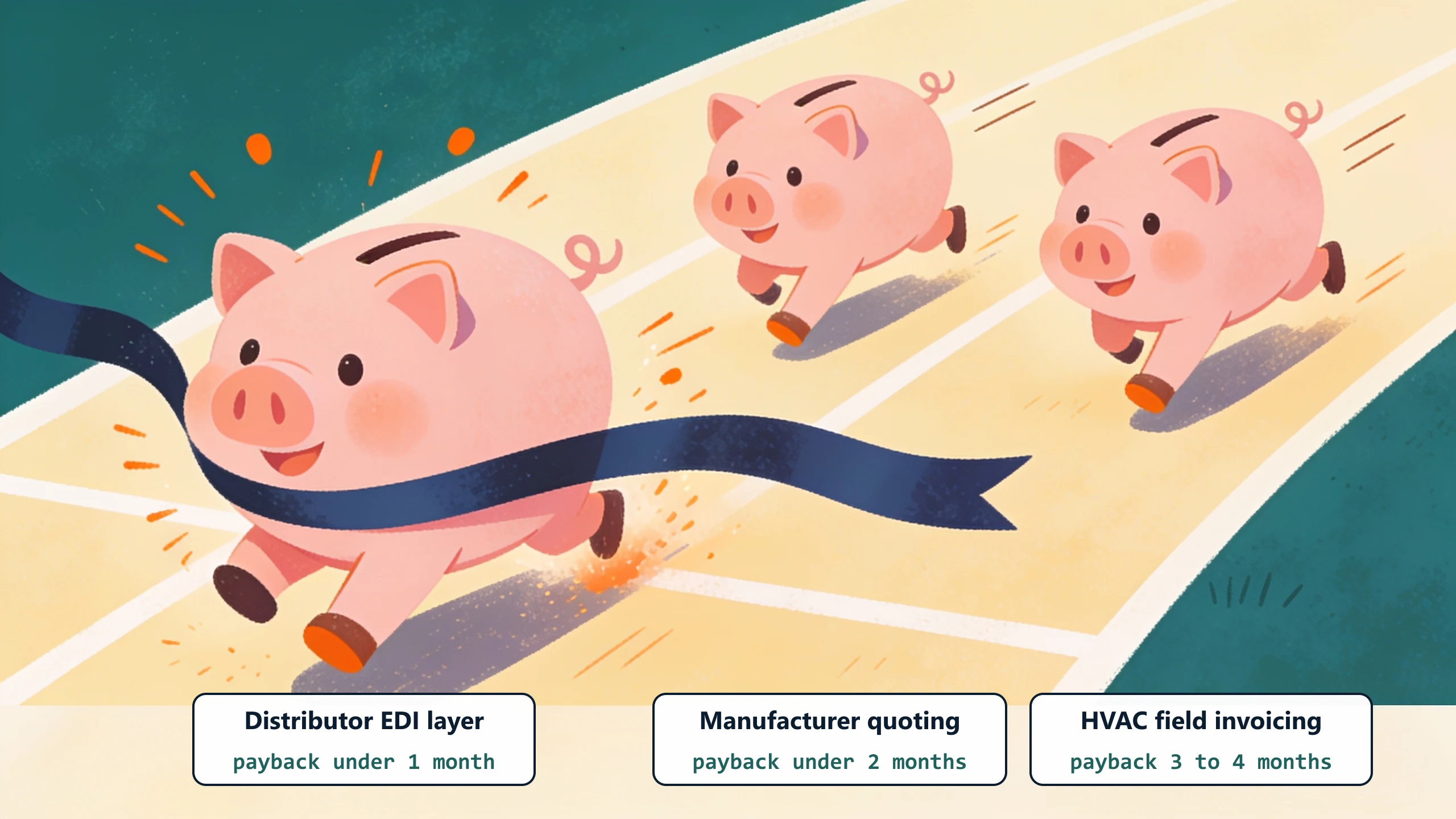
Custom-plus-managed mobile invoicing runs a flat monthly fee, well under the $44,000 current cost. The tool pays for itself well inside a year. ROI: clear.
Manufacturer with $4M revenue and a 25-hour-per-week estimator
Estimator time: $50/hour fully loaded x 25 hours x 50 weeks = $62,500. Plus an estimated 5 percent of bids lost due to slow turnaround on $4M revenue at a 12 percent win rate baseline: ~$24,000. Total: $86,500.
Custom-plus-managed quoting runs a flat monthly fee, a small fraction of the $86,500 current cost. The tool pays for itself well inside a year.
Wholesale distributor with $8M revenue and brittle EDI
EDI tool ($14,400/year) plus 12 hours per week of operations time reconciling failed transactions ($31,000 fully loaded). Plus an estimated 2 lost retailer relationships per year due to EDI errors at $40,000 average annual revenue per relationship: $80,000. Total: $125,400.
Custom-plus-managed integration layer runs a flat monthly fee, a small fraction of the $125,400 current cost. The tool pays for itself well inside a year.
What to do this week
Pick the workflow that bleeds the most time. Compute its current annual cost (salary of the bridging role plus SaaS subscriptions plus opportunity cost). Compare to $10,000 to $11,000 per year for custom-plus-managed. The math is usually obvious. Book a 30-minute discovery call and we will scope a pilot if the numbers support one.
No pitch, no pressure. We diagnose, you decide.
Have a question? We reply by email, no call needed.