

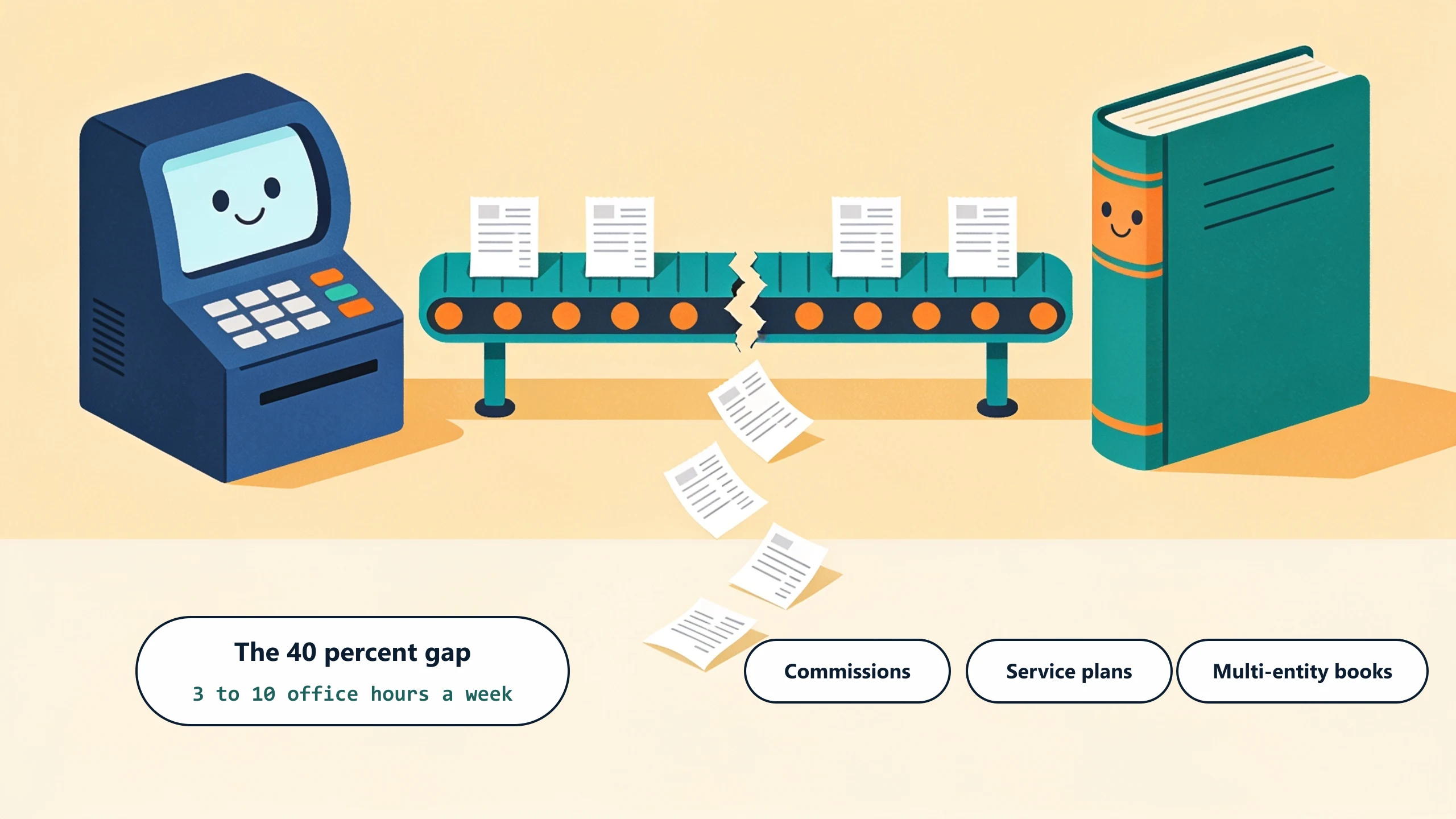
If you run a 10 to 50 employee HVAC, plumbing, or electrical contractor, you are probably running ServiceTitan for dispatch and QuickBooks for accounting. The two have a native integration. For plenty of shops that integration is "fine." For the rest, it is the source of three to ten hours a week of office-staff time.
The native integration: what it covers and where it stops
What the native integration does
ServiceTitan's QuickBooks integration handles the basics: customer sync, invoice export from completed jobs, payment posting, and a few accounting categories. It works in real time (Online) or via batch sync (Desktop).
If your shop runs flat-rate pricing, single-tier service plans, and a single QuickBooks file, the native integration will probably do what you need. You may never read this post.
What the native integration does not do
Common HVAC scenarios where the native integration falls short:
- Tech commission accruals. ServiceTitan tracks the job and the invoice. QuickBooks tracks the AR. Neither tracks "a tech earned a 7 percent commission on the $4,200 service plan they sold last Tuesday." That math runs in a spreadsheet at most shops, calculated at month end.
- Multi-tier service plans. If your service-plan offerings are nuanced (silver, gold, platinum, with different visit cadences and renewal terms), keeping ServiceTitan and QuickBooks in sync as plans renew, lapse, or get upgraded is a manual reconciliation.
- Multi-entity accounting. Many HVAC shops run multiple legal entities (residential, commercial, new construction). ServiceTitan does not natively split invoices across QuickBooks files; the office manager handles it.
- Inventory cost-of-goods reconciliation. The integration posts revenue. It rarely posts the COGS in a way that matches the actual parts pulled from inventory.
- Field-tech expense reimbursements. Truck stock, fuel, parts purchased on a tech card. These need to land in QuickBooks against the right job. Native integration does not handle that.
What HVAC shops typically end up doing
What we see most often, and the commission accrual is the one that breaks first in every trade shop we have wired into QuickBooks:
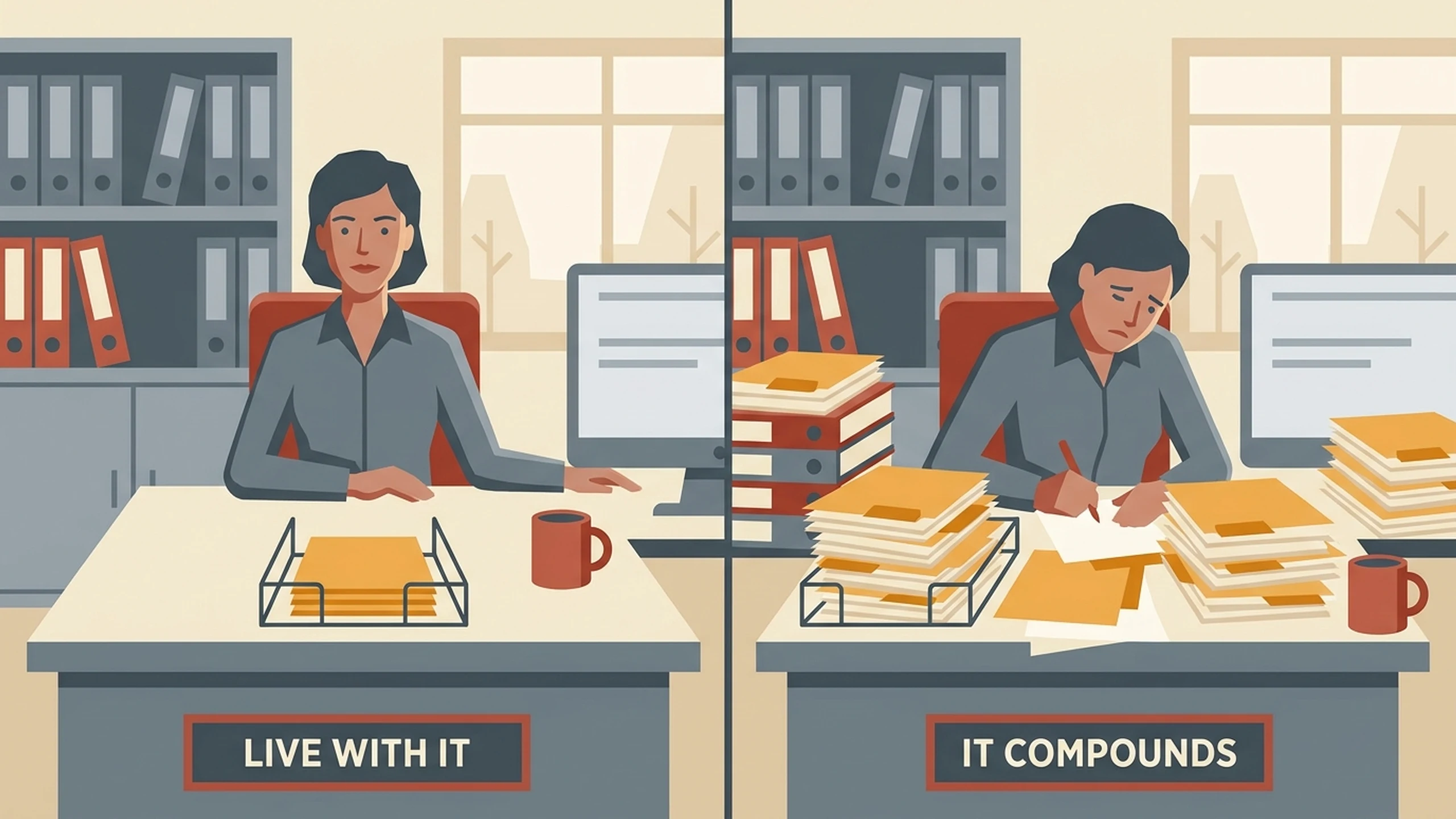
- Live with the gap and absorb the manual hours. Office manager spends 5 to 15 hours a week reconciling. Works at low volume. Breaks at growth.
- Hire a ServiceTitan implementation consultant to extend the native integration. Costs $5,000 to $25,000 for the build. Often partial. Maintenance is your problem.
- Add a low-code platform like Zapier between ServiceTitan and QuickBooks. Works for simple gaps (commission accrual specifically). Breaks at the multi-entity or multi-tier scenarios.
- Custom-plus-managed integration that lives between ServiceTitan and QuickBooks. Built around the shop's specific commission rules, multi-tier plans, and multi-entity setup. Maintained by the vendor for a flat monthly fee. See our auto-invoicing and commission engine example.
The test for whether you need option 4
Three signals:
- Your office manager spends more than 5 hours a week on ServiceTitan-to-QuickBooks reconciliation.
- Tech commissions are calculated by hand at month-end and disputes happen more than once a quarter.
- Cash flow is delayed because invoicing is "almost real-time but not quite."
If two of three are true, the math on a custom-plus-managed integration almost always pencils. A 7-hour-a-week office-manager task at fully-loaded $40 per hour is $14,560 per year, well above what a flat monthly fee on the Growth tier costs over the same stretch. The integration pays for itself well inside a year and removes the bottleneck.
What a 28-tech HVAC shop actually sees at month-end
Concrete picture of what option 1 (live with the gap) looks like once volume hits scale. A 28-tech residential HVAC contractor running ServiceTitan and QuickBooks Online, two legal entities (residential and commercial), three service-plan tiers, and tech commissions on service-plan sales:
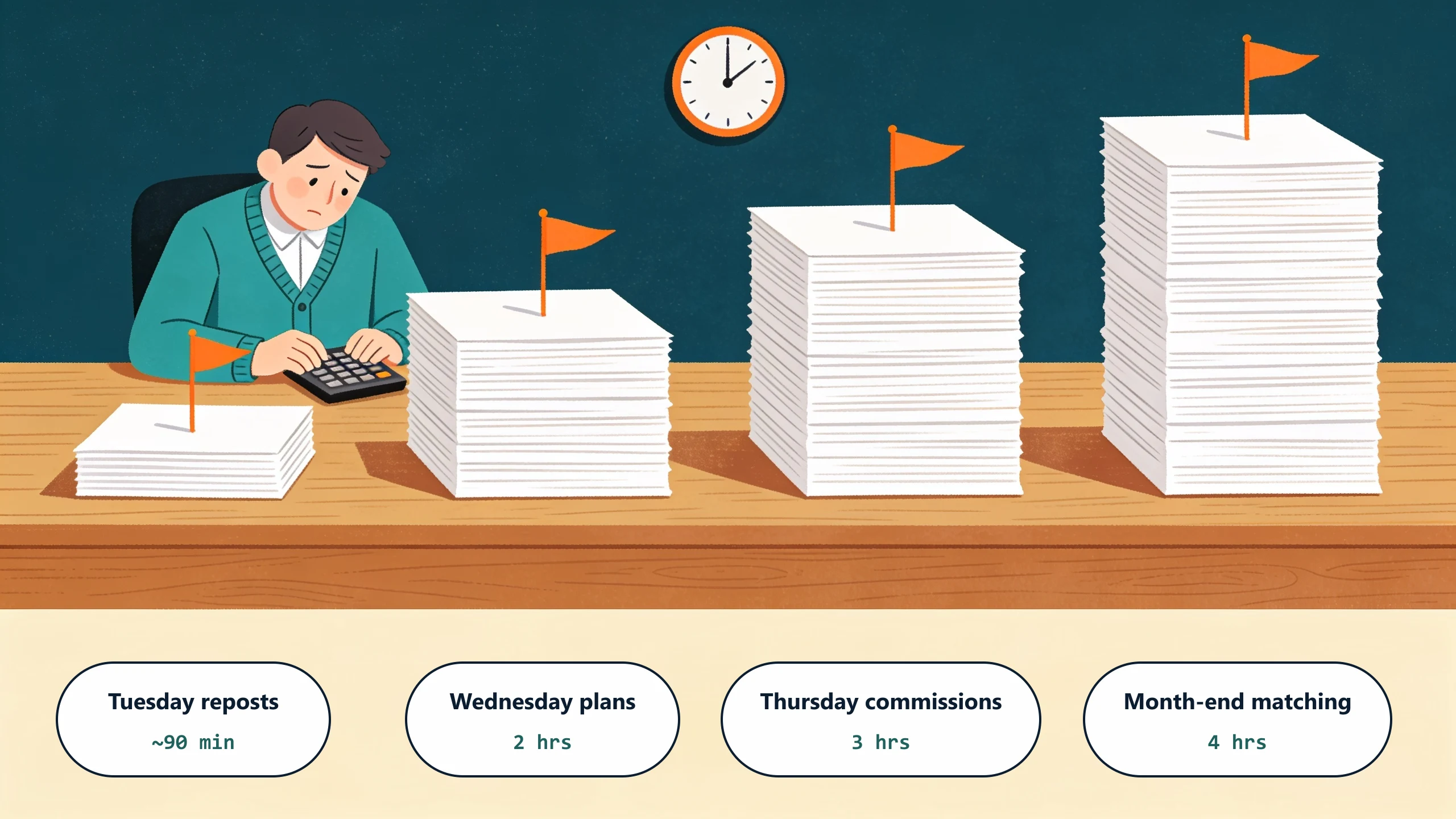
- Tuesday: Office manager pulls the prior week's job-completion list, cross-references against the QuickBooks invoice register, identifies the 12 to 16 jobs that did not auto-post because of multi-entity rule mismatches, and manually reposts each. Roughly 90 minutes.
- Wednesday: Service-plan reconciliation. Three tiers, 380 active customers across two entities. Renewals, lapses, and tier upgrades processed during the prior month need to be reflected in QuickBooks recurring invoices. About 2 hours, every month.
- Thursday: Tech commission accruals. Mike sold three silver plans, Sarah sold a gold and upgraded a silver. Each carries a different commission percentage. Office manager runs the math in a spreadsheet, then enters each commission as a separate journal entry. Roughly 3 hours per month.
- Month-end: Distributor invoices for parts and equipment matched against work orders, with cost-of-goods allocated to the right entity and the right job. About 4 hours.
Total: 9 to 10 hours per month of office-manager time on the named tasks, plus another 4 to 6 hours of small daily fixes that never make it into the formal "reconciliation" bucket because they get handled in passing. Call it 14 hours per month, 168 per year.
At a fully-loaded $40 per hour, that is $6,720 per year of office-manager time spent on integration gap. The same shop is also delaying invoicing by 2 to 4 days on the 14 weekly mismatched jobs, which is roughly $35,000 of AR that ages slower than it should. The combined cost is an order of magnitude larger than the annual cost of a custom-plus-managed integration on the Growth tier.
Why option 4 usually wins past 20 techs
Below 15 techs, the gap is small enough that option 1 (live with it) is rational. The office manager has slack hours. Adding a custom-plus-managed integration to fix a $3,000-a-year problem does not pencil.
Above 20 techs, the gap compounds because volume drives multi-entity, multi-plan, multi-comp-rule complexity simultaneously. Option 2 (consultant) is one-time work that does not survive the next ServiceTitan or QuickBooks update. Option 3 (Zapier) covers commission accrual but breaks on multi-entity. Option 4 (custom-plus-managed) is purpose-built for the specific shape of your shop and stays current contractually.
The shops that resist option 4 longest are usually the ones where the office manager is also the bookkeeper, the controller, and the part-time front-desk person. The cost of the gap is hidden inside one person's job description. Once that person leaves or asks for a raise, the math becomes visible fast.
What to do this week
Pull up ServiceTitan and look at how invoices flow to QuickBooks. Ask your office manager which scenarios cause the most reconciliation work. Note the top three. Walk us through them on a free 30-minute discovery call. We will tell you whether option 4 fits or whether your gap is small enough to live with.
No pitch, no pressure. We diagnose, you decide.
Have a question? We reply by email, no call needed.