

Cleaning, landscaping, pest-control, and facilities shops all hit the same wall. As commercial accounts take over the revenue mix, the residential software they started with becomes the bottleneck. Jobber, Housecall Pro, and Service Fusion are excellent for residential one-off work. They are not built for the recurring B2B model, where one customer has 14 sites, three pricing tiers, and a vendor portal that wants weekly updates. Here is what changes when you cross that line.
How commercial accounts break residential software
Three things happen once a commercial account becomes a real share of revenue.
One customer, many sites
A property management company has 12 buildings under contract with you. Each building has a service schedule, a different point of contact, and a different parking situation for your crews. Residential software treats each address as a customer. You end up with 12 fake customer records and a sales rep memorizing which goes with which.
Pricing is contract-based, not per-job
Commercial customers expect a monthly invoice at the contracted rate, with extras billed on their own. Residential software wants to bill per visit. So every month someone edits invoices by hand, or the pricing ignores the contract.
Vendor compliance is a cost center
Commercial customers require COIs with specific endorsements, vendor portal updates, and W-9s on file. Property managers, facilities groups, and big retail chains are the strictest. The residential apps do not track any of it. Most shops run it from a binder or a shared drive.

What the commercial workflow really needs
Strip away the platform pitches, and four jobs are doing the heavy lifting.
Account hierarchy
Customer at the top, multiple sites underneath, multiple service contracts per site. Each level has its own contact, schedule, and billing rules. The right system models this as a tree, not as a flat customer list.
Recurring contract billing
Monthly base rate per site, plus extras: one-off cleanings, emergency calls, added services. Each customer sets the invoice cadence (weekly, biweekly, monthly). They also set who gets the invoice and what format it arrives in.
Vendor compliance tracking
COIs with expiration dates and required endorsements per customer. Vendor portal credentials. Insurance certificates that need to renew on a schedule. The cost of letting a COI lapse is a lost contract.
The custom-plus-managed alternative
For shops with $1 to $10 million in commercial revenue, a custom layer over QuickBooks usually beats replacing the platform. It wins on price and on fit.
- Customer / site / contract hierarchy modeled correctly.
- Contract billing that sends each customer the right invoice, on their schedule, in their format.
- Crew day-board with mobile site notes and check-in tracking.
- COI and vendor compliance tracker with expiration alerts.
A one-time pilot fee, then a flat monthly fee. The model fits because the rules are customer-specific. Residential platforms cannot hold them without a workaround layer, and that layer becomes one more tool to maintain.
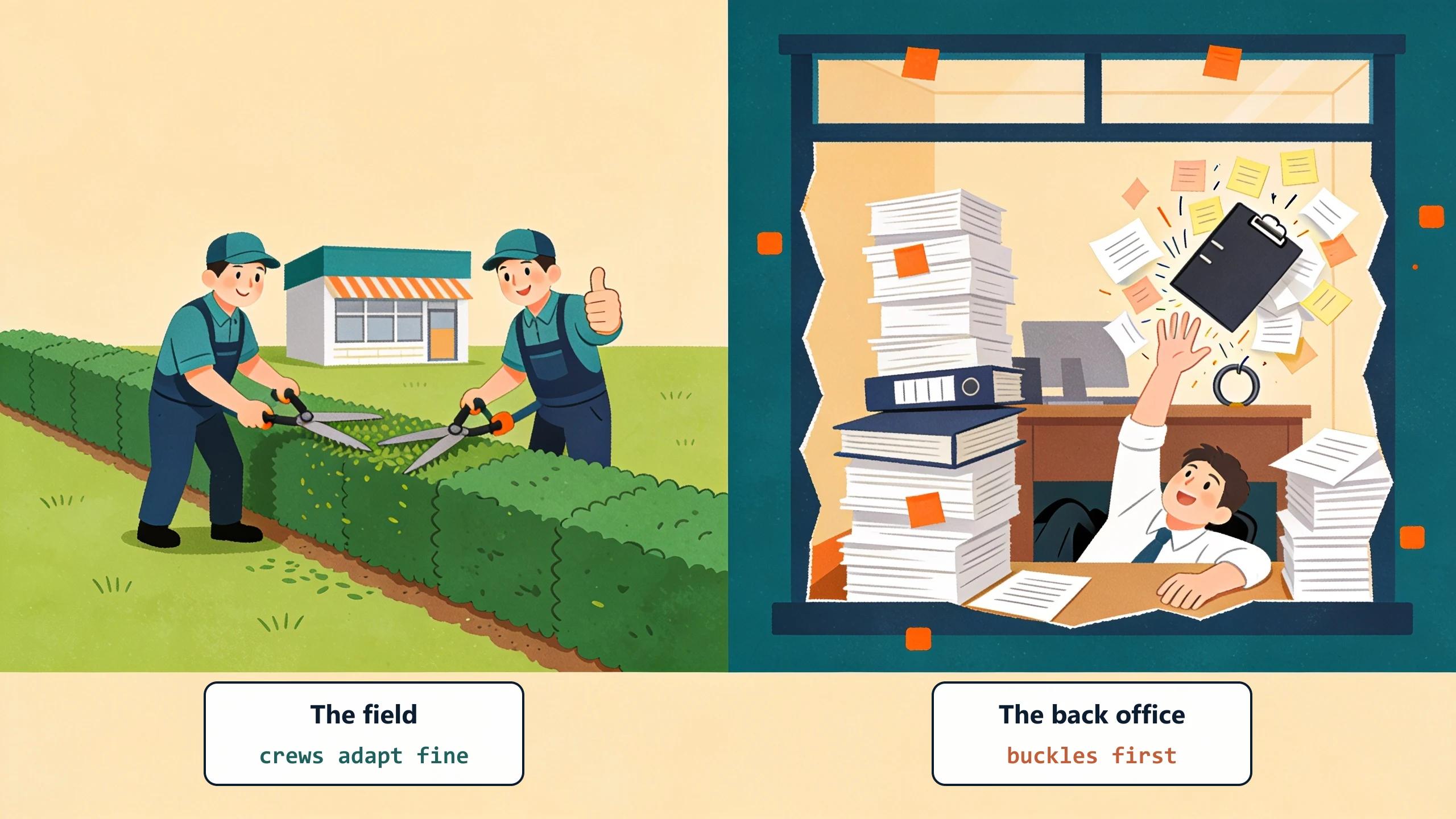
What we watch break, every time a consumer-services shop leans into commercial accounts, is never the field work. The crews adapt fine. It is the back office that buckles, where one account suddenly means a dozen sites, three pricing tiers, and a vendor portal demanding weekly updates that residential software was never shaped to hold.
What to do this week
Pull your top 10 commercial accounts by revenue. Count how many have multiple sites under one contract. Count how many require COIs or vendor-portal updates that nobody on staff currently owns. Pull last month's billing. How many invoices got manually edited before sending? Three or more is a signal. Bring the numbers to a free 30-minute discovery call.
No pitch, no pressure. We diagnose, you decide.
Have a question? We reply by email, no call needed.