
Mold shops do not quote like other manufacturers. The math spreads up-front tooling cost over an estimated run. Resin prices move weekly. Secondary operations get priced on parts that have not been molded yet. And the tooling stays at the shop for 5 to 15 years. Generic quoting tools (Paperless Parts, Quote Software, ProShop) handle most of this badly. Here is what a mold-shop system actually needs to do.
The four jobs that generic tools mishandle
Each one keeps producing mispriced quotes in shops that run general-purpose quoting tools.
Tooling cost amortization
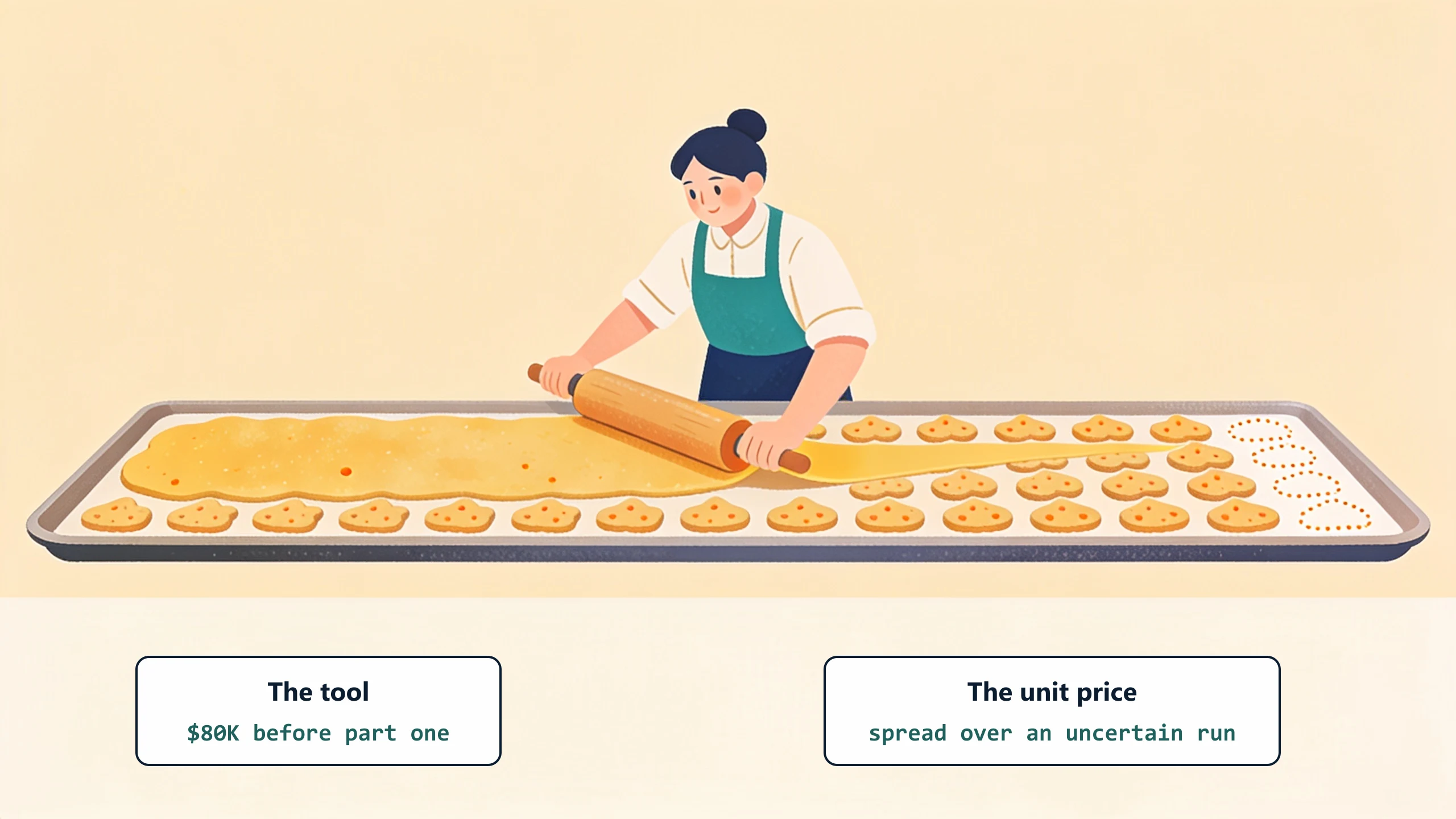
The customer wants a unit price. The shop has spent $80,000 on the tool. The unit price has to amortize the tool across an estimated run, a run that may or may not happen at the volume promised. Generic tools force you to either fold the tool into unit price (and over-price low-volume runs) or quote the tool separately (and lose the deal). Mold-shop tools handle this as a structured tooling-amortization decision with multiple scenarios.
Resin pricing volatility
Plastic resins (ABS, PC, PP, nylon, glass-filled grades) have prices that move 5 to 20 percent in a quarter. A quote built on a March resin price is wrong by August. The right system pulls current resin pricing into the quote engine and re-prices automatically when resin moves more than a configured threshold.
Secondary operations
The molded part needs trimming, painting, ultrasonic welding, assembly, packaging. Each operation has its own labor minutes, equipment time, and material costs. Generic quoting tools treat these as add-on line items. Mold-shop tools treat them as a structured routing on the part record.
Family tools and shared cavity sets
One tool can produce multiple parts (family tool) or share cavities across runs (shared tooling). The amortization logic is different. The quoting tool has to know.
What a mold-shop quoting tool actually needs
Strip away the marketing. Five capabilities matter.
Part-and-tool data model
Each part has a tool reference, a resin spec, a cavitation count, a cycle time, a routing of secondary operations. Each tool has a build cost, an amortization plan, a lifetime cycle estimate, and a cavity count. The data model captures both.
Resin price feed
Either a feed from a resin pricing service (Plastics News, Plastic Exchange, Resin Technology) or a manual update step with an audit trail. When resin moves, the tool re-prices active quotes.
Customer-specific scenarios
Same part, three customers, three volume tiers, three tooling terms. The tool stores the rules per customer and applies them on its own.
Quote-to-tool linkage
A new quote that uses an existing tool inherits the tool's amortization status. A quote that requires a new tool builds a separate tooling line. The customer sees one quote with two structured sections.
QuickBooks integration
Won quotes land in QuickBooks as orders with the right line items, sales tax, and customer reference. Tooling progress payments go out as their own invoices, on the schedule the customer signed.

The build vs buy decision
For most mold shops with $2 to $20 million in revenue, the realistic options are these.
The decision owners agonize over is usually the wrong one. They frame it as a price comparison, generic tool versus custom build, when the real question is fit: whether the parts of quoting that are specific to a mold shop (tooling amortization, resin that moves weekly, family tools) are the parts that actually drive their pricing. When those edge cases are the whole job, no amount of configuring a general tool closes the gap, and we have watched shops spend a year proving that before they accept it.

Generic SaaS plus heavy configuration
Paperless Parts, Quote Software, similar. Cost: $700 to $2,000 per month. Works at 60 to 70 percent. The 30 to 40 percent gap is mold-specific (tooling amortization, resin pricing, family tools). The shop closes the gap with spreadsheets next to the tool.
Custom-plus-managed quoting tool
Built around the shop's specific tooling logic, resin pricing, customer scenarios. A one-time pilot fee, then a flat monthly fee. The model fits because the rules are mold-shop-specific in ways that off-the-shelf tools cannot accommodate without becoming worse for everyone else. See the case study.
What to do this week
Pull your last 20 quotes. For each, count the manual steps the estimator did outside the quoting tool (resin price check, tooling amortization spreadsheet, secondary-operation lookup). Multiply by 20 and by 50 weeks. That is your annual estimator-overhead-on-quoting cost. Bring the number to a free 30-minute discovery call.
No pitch, no pressure. We diagnose, you decide.
Have a question? We reply by email, no call needed.