
Most small manufacturers do not need a $50,000 quoting platform. They need a system that captures the way their estimator already prices work, removes the version-control problem, and stops requiring a human to retype numbers into QuickBooks. The path from Excel to that system is shorter than the SaaS sales pitch suggests.
When Excel quoting starts to break
Excel is fine for the first hundred quotes a year. Past that, three failures show up in roughly this order. If two of them sound familiar, the spreadsheet is no longer carrying the load.
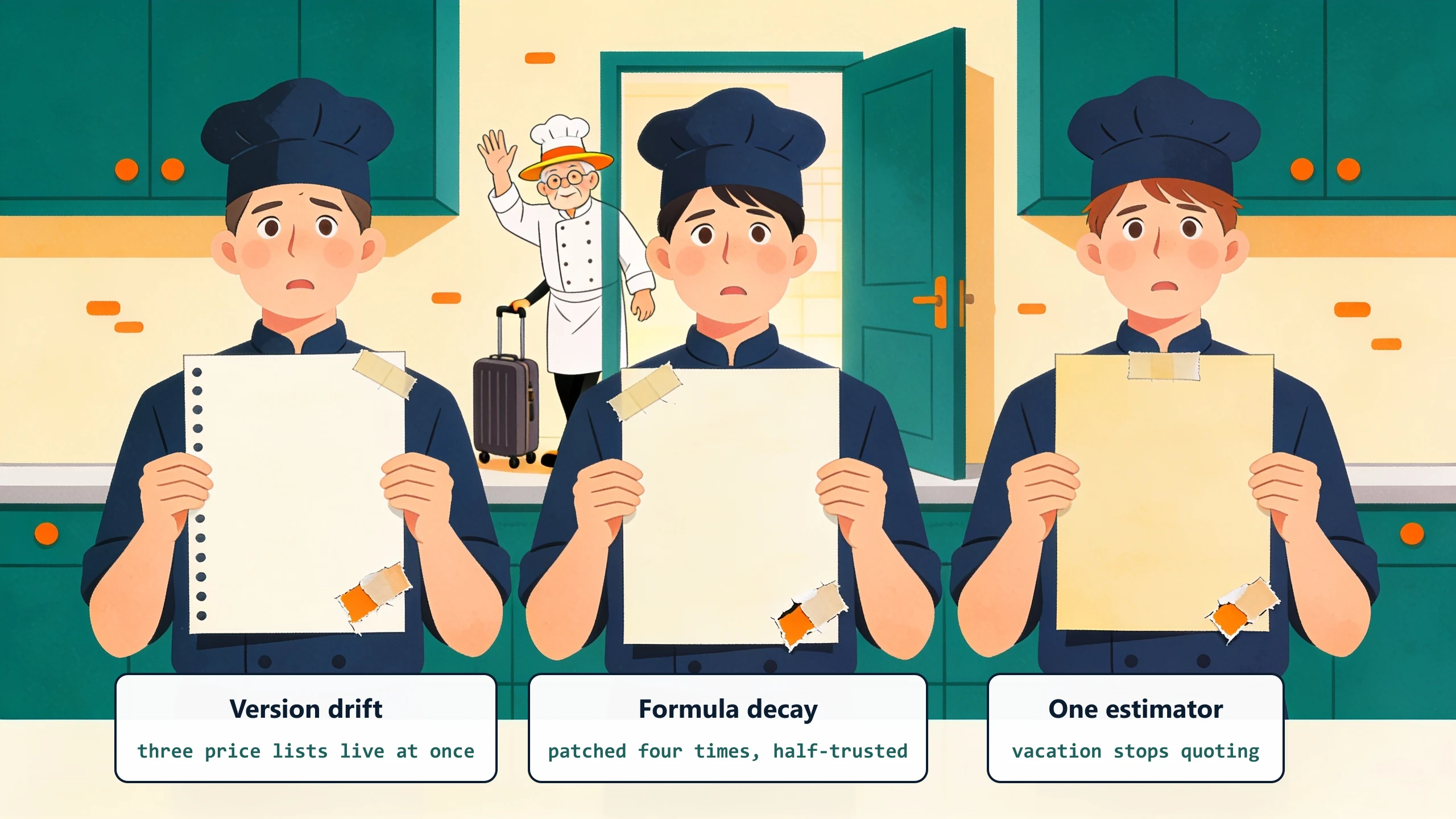
Version drift
Quote 47 was built from a 2024 master template. Quote 81 was built from a 2025 master that fixed a margin bug. Nobody updated the older quotes. Now you have three customers paying off three different price lists for the same part, and the estimator cannot remember which version was current when. The fix is not "be more disciplined." Excel is not a database.
Formula decay
The cost-per-pound formula in cell K12 worked when raw stock came from one supplier. Now you have three suppliers, two finishes, and a surcharge tied to alloy market price. The formula has been patched four times. The estimator no longer fully trusts it and quietly does the math on a calculator before typing the answer in.
The estimator bottleneck
One person knows how to price work. They are also the only person who can produce a quote without escalating. They take a vacation, quoting halts, and three customers go elsewhere. This is not a staffing problem. It is a knowledge-trapped-in-a-spreadsheet problem.
What a real quoting system actually does
Strip away the marketing, and a quoting tool worth running has three jobs.
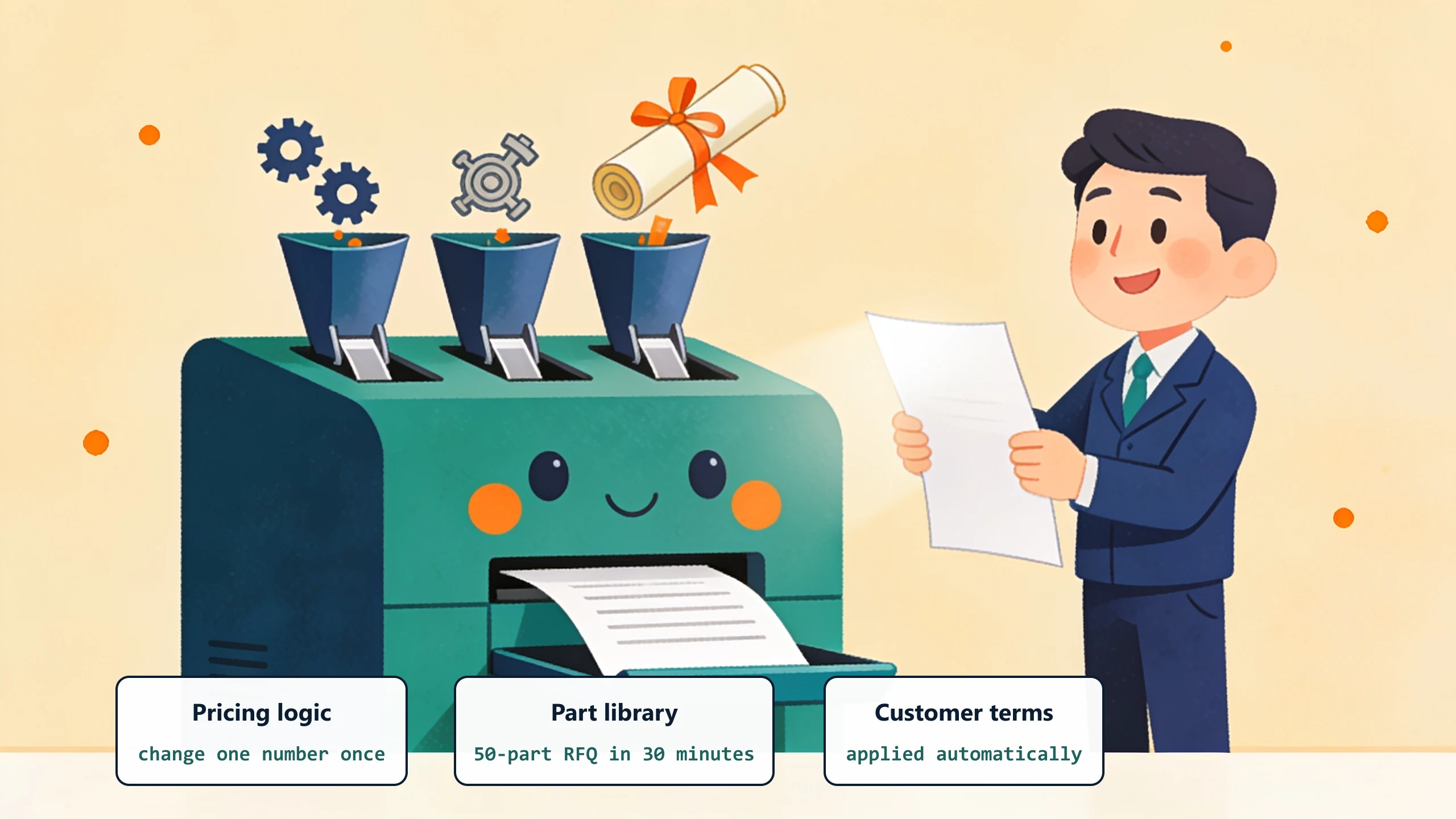
The pricing logic
Encoded once, applied consistently. Material cost, labor minutes, machine time, finishing, shipping, margin. When alloy prices move, you change one number. Every active quote reflects the change.
The part library
Reusable part definitions with their associated routings, materials, and standard times. New quotes pull from the library instead of being rebuilt from scratch. A 50-part RFQ becomes a 30-minute job, not a two-day job.
The customer terms
Each account has negotiated terms (volume tiers, payment terms, kit pricing). The system applies them automatically. The estimator stops having to remember which customer gets which discount.
Three paths to get there
For a small small and medium manufacturer, the practical options are these.
Configurable SaaS
Paperless Parts, Steelhead, Quote Software, ProShop. Strong tools for shops whose pricing fits the vendor's model. Cost: $400 to $1,500 per month plus a 4 to 8 week implementation. Risk: if your pricing logic is unusual (volume-tier kits, alloy surcharges, customer-specific overhead), you spend the implementation period bending the SaaS to fit.
Custom build, project-based
$25,000 to $75,000 from a regional dev shop. 4 to 6 months. Maintenance becomes your problem after launch. Works if you have a technical owner-operator who can absorb post-launch maintenance. Most small shops do not.
Custom plus managed
The model ByteQuix uses. $800 pilot in 1 to 3 weeks for a working tool against your real data. Then $295 to $895 per month flat. Maintenance, refinements, and small changes are included. Built around your pricing logic, your part library, your customer terms, your estimator's edge cases. See the mold-shop quoting tool case study for a real example.
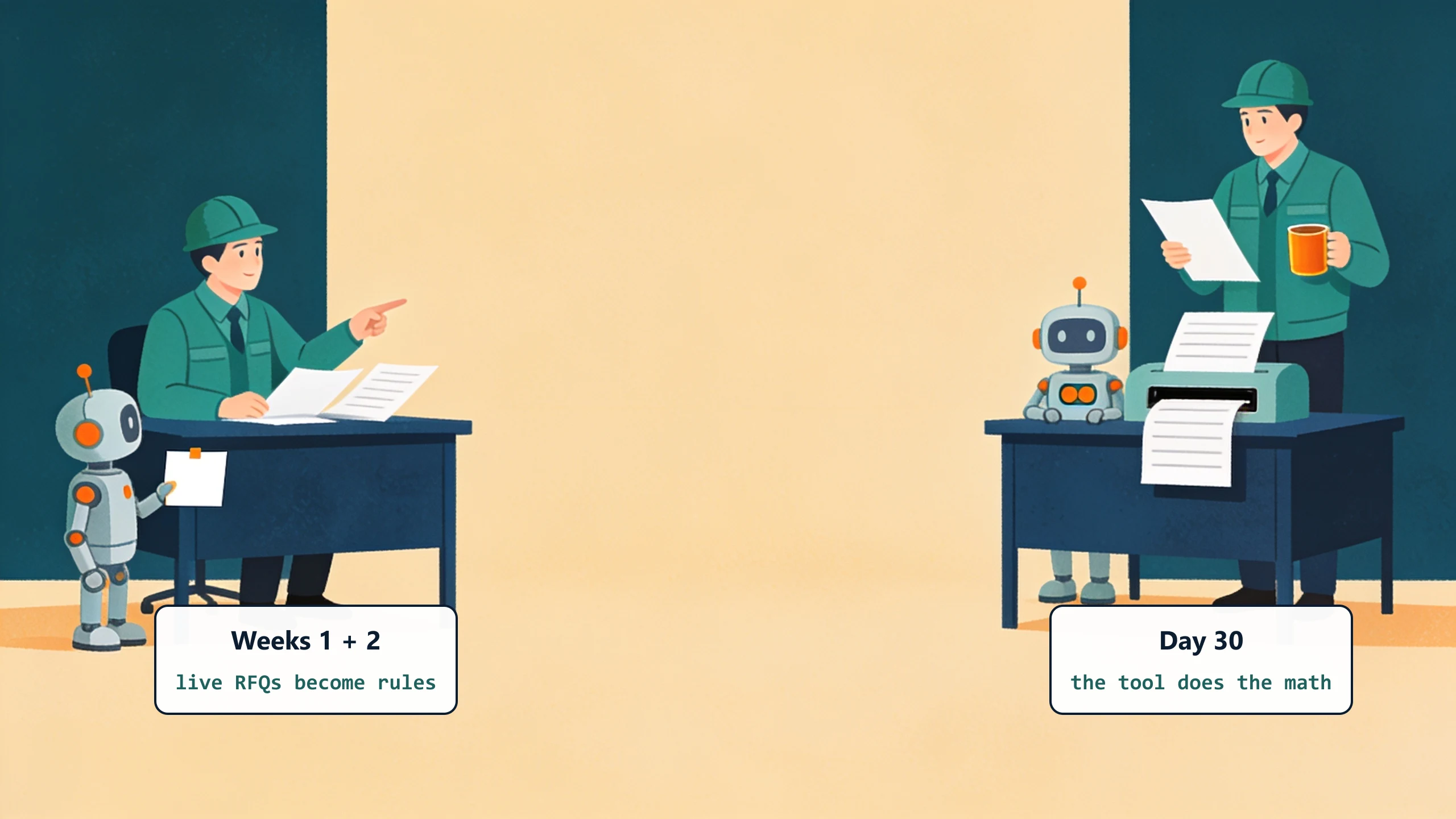
Weeks one and two, we turn the estimator's live RFQs into the rules behind the tool: which surcharge applies, when a quantity break kicks in, why one customer carries a different overhead number. By day 30 we have those rules running underneath one input form, and the estimator stops re-typing the same math and starts checking what the tool returns.
What to do this week
Walk over to the estimator's desk. Ask: "If I had to quote this RFQ without you in the room, what would I get wrong?" The answers are a free brief for whoever builds the tool. Three or four answers are enough. Bring them to a free 30-minute discovery call and we will tell you whether a custom-plus-managed pilot is the right next step. If it is not, we will say so.
No pitch, no pressure. We diagnose, you decide.
Have a question? We reply by email, no call needed.